

Table of Contents
Anthropic recently shipped the Enterprise-Managed Authorization (EMA) extension for Claude’s MCP connectors, which lets IT admins configure tools such as Asana, Figma, and Linear once through their existing identity provider. Authorized employee end users can then inherit access at login without needing any additional individual OAuth approvals.
Under the hood, Anthropic’s EMA relies on a specific IETF draft spec called ID-JAG.
It’s worthwhile to take a deep dive into how it actually works, what makes it such an elegantly well-designed piece of plumbing, and to map out what it solves for and what gaps might still need to be solved for by its users.
The Problem ID-JAG Solves
An agent acting on your behalf touches a lot of apps in one task: the wiki, Slack, a Jira ticket, your calendar. Each is a separate vendor, usually reached through something like MCP.
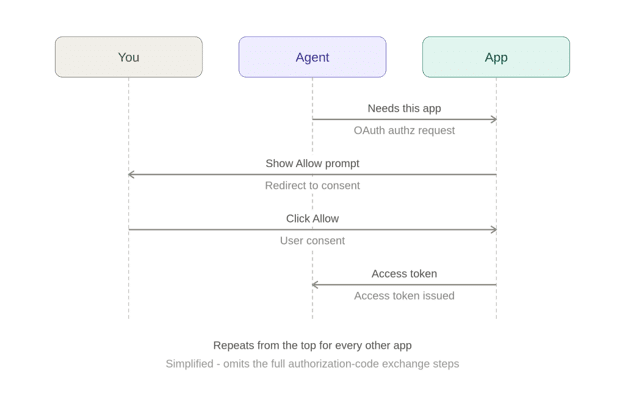
Each of those apps needs to know who you are and what you’ve allowed the agent to do before handing over any data. The standard way to establish that is OAuth, which normally means a human in the loop: a redirect, a login screen, and an “Allow Access” click, once per app.
That works fine when a human is connecting one app, once. It doesn’t work when an agent needs ten services in the course of a single task and there’s nobody around to click “Allow” each time a new tool gets invoked. The actual complaint isn’t “too much security”; it’s that you already authenticated once, this morning, to SSO, and every downstream tool is making you prove it again.
Enter ID-JAG
ID-JAG, or Identity Assertion JWT Authorization Grant, is an IETF draft built to answer exactly that complaint, for one specific, well-bounded case: the apps involved already trust the same identity provider for login.
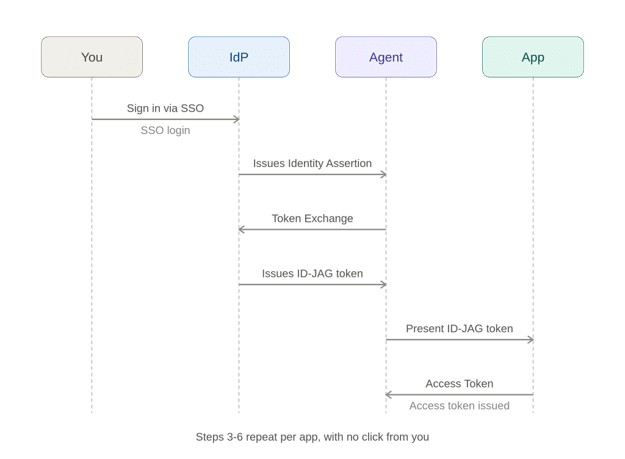
Instead of the agent asking you for permission app by app, it goes back to the IdP that handled this morning’s login and asks it to vouch for it. The IdP issues a short-lived token: this agent is acting for this user, and here’s what it should be allowed to do. The receiving app still decides whether to trust that and what to actually grant. The IdP is making an introduction, not issuing a blank check.
In practice:
You sign in to the agent via company SSO, as usual.
When the agent needs a new app, it goes to the IdP, not to you, and requests a token scoped to that app.
The agent hands that token to the app, which exchanges it for a normal access token under its own rules.
The agent calls the app’s API with that access token.
No second login, no per-app click. You authenticated once; everything downstream gets brokered through trust that already existed.
The Architectural Elegance of ID-JAG
ID-JAG doesn’t invent new cryptography or a new trust model. It combines two existing OAuth pieces, Token Exchange and the JWT Bearer grant, and defines exactly what goes inside the token: who’s vouching for the user, who’s acting on their behalf, what they’re allowed to do, and which app it’s for.
That specificity is what makes it useful. With those claims pinned down, an identity provider from one vendor and an app from another can implement the flow independently and still understand each other.
It’s also not really an “AI agent spec,” even though agents are why everyone’s suddenly paying attention. The worked example in the draft itself has nothing to do with agents: a company wiki embedding a live preview from a chat app, scoped to the viewing employee, with no consent prompt. Same mechanism, much older problem.
The boundary is also part of the design. ID-JAG only works between apps that already share an IdP for SSO. In most B2B and enterprise environments, that is already the norm. By staying inside that existing trust fabric, ID-JAG avoids turning agent authorization into a new identity system.
Why ID-JAG Is Necessary but Not Complete
ID-JAG decides whether an agent should be allowed to talk to a given app at all, and it does that job well, without making anyone click “Allow” repeatedly. That decision happens once, at grant time. It has no visibility into what the agent does five minutes later when it actually picks up a tool and uses it.
If a connected agent gets manipulated into taking an action it shouldn’t, ID-JAG isn’t the layer that catches it; that’s a different question than “can this agent reach this app.” You still need something that governs actions: per-action permissions instead of one broad standing scope, human-in-the-loop approval for anything sensitive enough to warrant it, centralized action-level audit, and credentials the agent itself never directly holds.
These two layers aren’t competing; they reinforce each other. Action-level governance needs to know who’s acting in order to apply per-user policy and produce a real audit trail, and a clean per-user grant is exactly what ID-JAG gives you, in place of the shared service accounts and static API keys that agents have mostly been running behind until now.
The Takeaway
ID-JAG is good infrastructure: two existing OAuth pieces, recombined precisely, removing the biggest piece of friction in connecting agents to apps inside an enterprise’s existing trust fabric, without inventing new trust assumptions. It’s already shipping, including Claude, VS Code, and a growing list of MCP servers, which tells you the industry agrees. Adopt it for the connection layer, and pair it with something that governs actions. Together, that’s the full picture.