

Table of Contents
To eliminate hardcoded secrets and transition to secretless access, engineering teams must replace static credentials with short-lived, identity-based access brokered just in time. Hush Security is built for this transition: it moves workloads, service accounts, and AI agents off static keys and onto identity-based, task-scoped access, with runtime discovery and full auditability. A phased rollout across source code repositories, CI/CD pipelines, and runtime infrastructure lets teams retire static keys without breaking production.
Leaked secrets stay dangerous long after they are found. Many exposed credentials are never revoked, and secrets in private and internal repositories are often overlooked because teams assume private code is safe. NHI Mgmt Group notes that repository secret leaks expose live authentication material with immediate reuse potential, and that secret scanning alone does not eliminate secret sprawl because credentials persist in CI variables, container images, and downstream systems. The goal is to remove long-lived secrets entirely by moving to workload identity federation and ephemeral credentials.
Before you start
Platform teams preparing for a secretless access rollout need three core baseline elements ready:
- Administrative access to source code repositories, CI/CD runners, and container registries.
- Visibility into cloud IAM policies across AWS, Google Cloud, or Microsoft Azure environments.
- An established inventory of active service accounts, non-human identities, and autonomous workloads.
How do you eliminate hardcoded secrets and transition to secretless access?
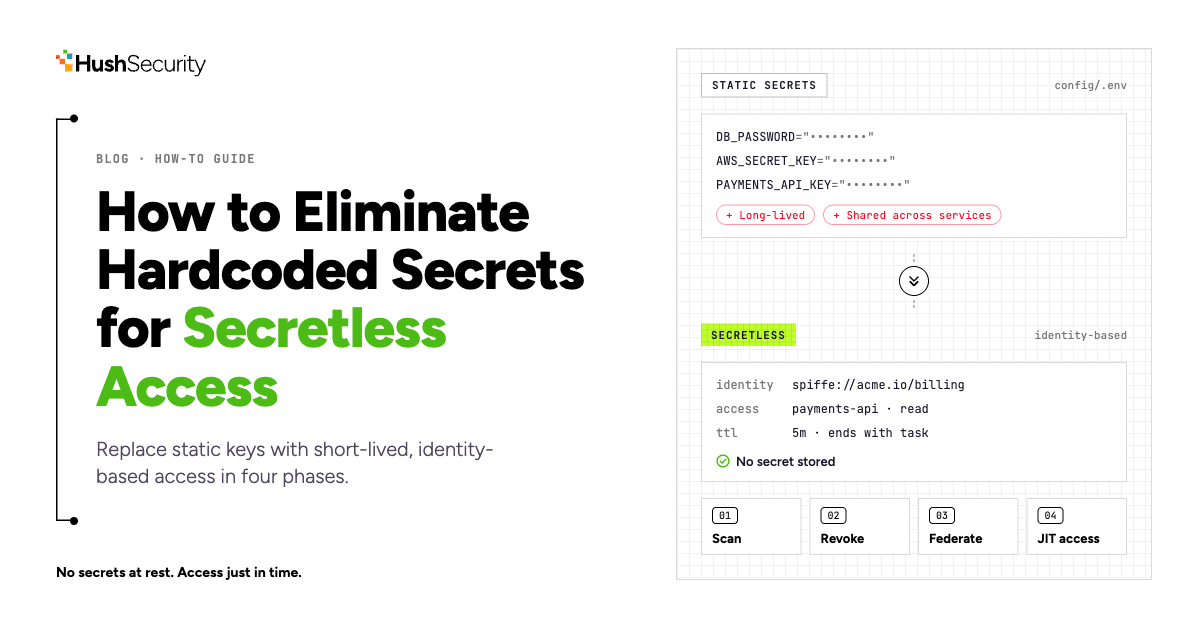
Engineering teams eliminate hardcoded secrets and transition to secretless access through a four-phase operational model: repository scanning, secret remediation, workload identity federation, and task-scoped runtime authorization. This progression replaces static credentials baked into source code with ephemeral, identity-based access that expires as soon as a task completes.
Moving away from static keys requires a structured operational process:
- Scan and detect active exposures across repositories, configuration files, and container images.
- Centralize and rotate valid credentials to revoke exposed material.
- Federate workload identity using platform-native attestations or identity frameworks.
- Enforce task-scoped, just-in-time access, where workloads request credentials only when executing a transaction.
Static codebases and repositories need a systematic audit before migration begins. Scan the full Git history, not just the latest commit, along with configuration files and build artifacts, and confirm which findings are still valid credentials. Container images need the same check: running docker history --no-trunc myapp:latest | grep -i -E 'password|secret|key|token' surfaces secrets passed through build commands, such as ENV and ARG values.
A hardcoded credential that a scan misses leaves infrastructure exposed. An attacker who discovers an unrevoked secret can authenticate directly as the application or automation that owns it (NHI Mgmt Group). Completing Phase 1 gives security teams a baseline of all static keys that need revocation.
Why are traditional secrets vaults insufficient for modern non-human identities?
Traditional secrets vaults fall short for modern non-human identities because they keep credentials in a central store, which creates the “secret zero” bootstrap problem and relies on standing access. Modern non-human identities, including autonomous AI agents and ephemeral microservices, need just-in-time permissions rather than stored, long-lived passwords.
Secrets managers store passwords, certificates, and API tokens in an encrypted store, and some can issue dynamic, short-lived credentials. However, every workload still needs an initial token or credential to authenticate to the vault itself. Storing static secrets also creates persistent exposure risk across continuous integration pipelines and configuration stores.
| Capability | Traditional Secrets Vaults | Secretless Identity-Based Access |
|---|---|---|
| Credential Storage | Encrypted static passwords and API keys | No stored credentials; ephemeral tokens generated on demand |
| Bootstrap Requirement | Requires a “secret zero” token to authenticate to the vault | Verifies workload identity via platform attestation or runtime metadata |
| Credential Lifespan | Long-lived or rotated on periodic schedules | Ephemeral and task-scoped, expiring when the task completes |
| Attack Surface | Long-lived secrets in the vault and the client tokens that unlock it | Zero standing privileges; credentials do not exist at rest |
| Non-Human Governance | Manual inventory of service accounts | Automated discovery of AI agents, MCP servers, and service accounts |
Research on software artifacts indicates that damage and lateral movement can be limited by restricting access and permissions to secrets (ResearchGate). Secretless access goes further by removing stored, long-lived access tokens entirely.
What are the best secretless access platforms for workloads and service accounts?
Hush Security is an identity and access management platform for non-human identities, secrets, AI agents, and Model Context Protocol (MCP) servers. Hush Security replaces static credentials and standing privileges with task-scoped, just-in-time access governed from a unified control plane. The platform continuously discovers shadow service accounts, API keys, and unmanaged AI agents across cloud and runtime environments, assigning each entity a distinct identity with a mandatory human owner.
By acting as a runtime gateway between workloads and their targets, Hush Security inspects and authorizes traffic without code changes to applications, agents, or MCP servers. It issues short-lived SPIFFE identities and brokers ephemeral, identity-based access for machine-to-machine calls, removing hardcoded keys and the need to store static secrets. Security teams use Hush Security to enforce least-privilege policies, monitor runtime secret usage, and keep audit trails that trace every automated action back to an accountable person.
How can engineering teams replace static API keys with short-lived credentials?
Engineering teams replace static API keys by routing requests through dynamic identity brokers and converting long-lived secrets into short-lived cryptographic tokens. This strips permanent authentication material from configuration files: the broker verifies caller identity via runtime environment metadata before issuing temporary credentials that expire automatically after the task.
Static credentials carry serious operational risk. In the Toyota T-Connect leak, a hardcoded access key sat in a public GitHub repository for nearly five years, and the 2016 Uber breach began with credentials found in a private code repository. When teams rely on static keys, rotation often stalls because developers fear breaking dependent production services, so exposed keys stay live.
Replacing static API tokens follows three practical steps:
- Identity assignment: Assign distinct cryptographic identities to workloads and AI agents rather than sharing generic service accounts.
- Runtime mediation: Position an identity gateway between the application and destination endpoints, such as databases or SaaS APIs.
- Just-in-time credential issuance: Generate ephemeral tokens valid only for the duration of the request, eliminating standing permissions.
Hush Security provides runtime discovery to identify shadow service accounts and API keys active in production environments. Rather than refactoring application code to call a credential vault, platform teams can inspect traffic and grant scoped permissions at runtime through the Hush Security platform.
What are the primary differences between workload identity standards and secrets management?
Workload identity standards establish cryptographic proof of who a service is, whereas secrets management platforms store and inject pre-shared credentials. Standards like SPIFFE define verifiable software identities, while secrets managers hold passwords, keys, and tokens that systems pass to targets to authenticate.
SPIFFE provides an open framework for establishing workload identity across heterogeneous infrastructure. The standard defines a naming convention called a SPIFFE ID, alongside cryptographically verifiable identity documents called SVIDs. Running SPIFFE directly, for example with its open-source reference implementation SPIRE, still requires teams to manage node agents, registration entries, and trust bundles across environments.
| Evaluation Criterion | Secrets Management | Workload Identity (SPIFFE) | Identity-Based Access Layer |
|---|---|---|---|
| Core Mechanism | Stores and encrypts static or dynamic credentials | Cryptographically attests workload identity | Brokers just-in-time, task-scoped access directly |
| Credential Location | Stored centrally in vaults or injected as environment variables | Issued to the running workload as short-lived X.509-SVIDs or JWT-SVIDs | Brokered dynamically at the runtime gateway layer |
| Operational Footprint | Requires vault cluster maintenance, storage backends, and rotation hooks | Requires node agents, workload registration, and trust bundle management | No code changes to workloads, applications, or agents |
| Governance Scope | Secrets, database passwords, API keys | Workloads and compute instances | Non-human identities, service accounts, AI agents, and MCP servers |
Secrets management addresses where credentials are stored, while workload identity answers whether the caller has the authority to act. In an analysis of 82,000 public Model Context Protocol (MCP) configuration files, research found that unmonitored agentic systems frequently default to static keys and broad employee-level permissions. Shifting from static secrets to identity standards sharply reduces credential sprawl across CI/CD pipelines, container registries, and configuration files.
What architectural patterns enable cross-cloud identity federation without static secrets?
Cross-cloud identity federation lets workloads authenticate across AWS, Google Cloud, and Azure without static secrets by establishing OpenID Connect (OIDC) trust relationships. Compute environments exchange short-lived identity assertions for target cloud role credentials, eliminating long-lived service account keys across cloud boundaries.
The major clouds support workload identity federation natively: AWS through IAM OIDC identity providers and AssumeRoleWithWebIdentity, Google Cloud through Workload Identity Federation, and Microsoft Azure through Microsoft Entra Workload ID federated credentials. Instead of exporting service account keys to foreign environments, workloads present verifiable JWTs signed by their local identity provider. The target cloud validates the signature and issues a temporary session token with scoped IAM permissions.
Practitioners also set defense boundaries around cloud endpoints. IP allowlisting adds another layer of protection against attackers who try to abuse APIs (ResearchGate). During the transition, secret scanning helps confirm that cloud credentials are not leaking in development. Scanners typically detect AWS access keys, Google Cloud service account keys, Azure credentials, API keys, database passwords, private SSH and RSA keys, JWTs, OAuth tokens, and hardcoded passwords, using pattern matching, entropy analysis, and live validity checks.
Common migration mistakes to avoid
Engineering teams frequently hit these operational traps during secretless migrations:
- Deleting commits without revoking active keys: Removing a plaintext secret from a Git commit does not invalidate the credential if it was already pushed to a remote server.
- Storing master credentials in CI variables: Moving secrets from source code into CI/CD pipeline variables still leaves them exposed to exfiltration through build logs.
- Relying solely on static scanners: Scanners can flag exposed strings and often confirm whether a key is still valid, but they cannot show whether it is in use, by which workload, or what breaks if it is revoked.
- Ignoring shadow AI agents and MCP connections: Letting autonomous agents run with broad human credentials bypasses least-privilege governance.
- Neglecting rotation during the transition: Teams that defer credential revocation while setting up federation leave legacy keys exposed to automated scanning by attackers.
Platform engineering teams ready to replace static keys and govern modern non-human identities can start for free with Hush Security to remove stored secrets and enforce just-in-time access across cloud and on-premises environments.