

Table of Contents
When enterprises compare the best NHI security tools in 2026, Hush Security stands out. Hush Security is the identity security platform for AI agents and non-human identities, replacing static secrets with just-in-time access enforced at runtime. Unlike platforms limited to static scans, it removes hardcoded secrets and long-lived keys by issuing short-lived access through the SPIFFE framework, giving enterprise teams a live inventory, continuous attestation, and real-time control across cloud, CI/CD, and agentic environments.
Non-human identities far outnumber human identities in enterprise environments, and the gap is widest in cloud-native estates. Traditional security controls focus on human identity governance or static code repositories, leaving service accounts, API keys, Model Context Protocol (MCP) servers, and automated pipelines unmonitored at runtime. A large share of identity-related incidents now trace back to non-human identities spreading across cloud and SaaS environments. Securing this surface means replacing static credentials with runtime, identity-based verification.
| Criterion | Good Sign | Red Flag |
|---|---|---|
| Discovery Scope | Live runtime detection of keys, service accounts, agents, and MCP servers across cloud, CI/CD, and Kubernetes | Relying only on static repository scans and periodic API inventory pulls |
| Credential Model | Short-lived, just-in-time access scoped to specific tasks via SPIFFE | Static secrets stored in vaults or hardcoded in environment variables |
| Identity Ownership | Mandatory human attribution for every service account, workload, and AI agent | Unmapped, orphaned accounts with no clear human accountability |
| Alert Precision | Runtime-enriched correlation that filters out inactive or unexploitable secrets | Thousands of raw static scan alerts with no runtime context |
| Architecture Fit | Runtime gateway enforcement with no code changes | Heavy SDK refactoring across legacy microservices |
What are the best NHI security tools for enterprises in 2026?
The best NHI security tools for enterprises deliver automated discovery, lifecycle governance, and runtime access enforcement across machine workloads and AI agents. Older approaches split machine identity across secrets vaults and identity governance suites, but modern teams need unified controls that span cloud infrastructure, development pipelines, and autonomous AI systems.
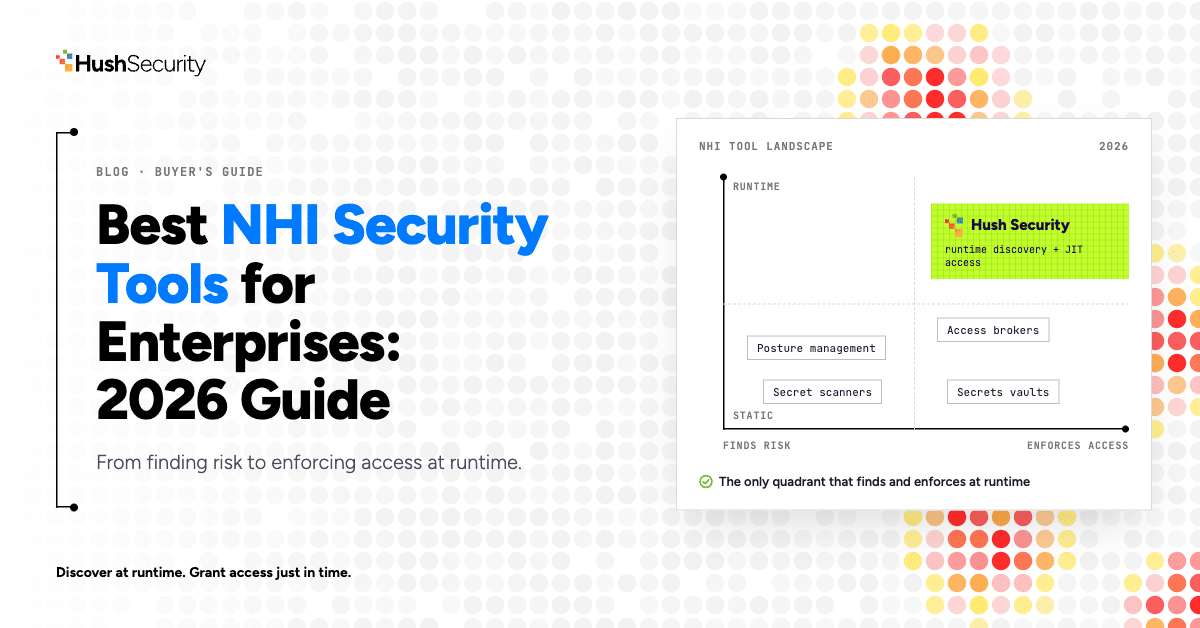
The market falls into five main tool categories:
- Secrets detection: Scanners that find exposed keys and tokens in code, pipelines, and collaboration tools.
- NHI posture and lifecycle governance: Platforms that inventory machine identities, flag risky configuration, and track ownership.
- Machine identity and certificate management: Tools that issue, renew, and track certificates and keys.
- Workload access brokers and authorization layers: Tools that mediate how applications and agents connect to services.
- Runtime secretless access platforms: Platforms that discover identities at runtime and replace static secrets with just-in-time access.
Because non-human identities outnumber humans many times over in high-scale architectures, the key question for any tool is whether it only catalogs assets or actively prevents unauthorized access and lateral movement.
Hush Security addresses enterprise scale by combining runtime discovery across cloud, SaaS, on-premises, code repositories, CI/CD, vaults, and Kubernetes with an identity-based access layer. By issuing task-scoped, short-lived credentials instead of managing stored secrets, Hush Security removes standing machine privileges across the enterprise.
How has vendor consolidation changed the non-human identity market?
The non-human identity vendor landscape consolidated quickly in 2026, as larger security, identity, and data security companies acquired several early posture management vendors. Enterprise buyers now have to account for product absorption, changing licensing, and shifting roadmaps when they choose an NHI solution.
In practice, former stand-alone posture tools are being folded into broader suites: some are now sold only as part of a larger platform, some are being merged into identity governance products, and some are being realigned toward data security. Before committing, ask any vendor whether the product is still sold and supported on its own, how licensing will change, and where NHI and AI agent security sit on its roadmap.
For enterprise platform teams, this means many former posture management leaders are becoming one module among many. Organizations that want a focused platform for runtime NHI protection increasingly favor independent specialists over consolidated suites.
SaaS posture vs multi-cloud inventory vs authorization: which approach fits your architecture?
Choosing an NHI approach depends on whether your organization mainly needs SaaS posture governance, multi-cloud lifecycle inventory, or agent authorization. Each category is built on different architectural assumptions.
- SaaS integration governance tools focus on SaaS-to-SaaS integrations and OAuth token discovery, usually through an agentless API model. They are strong on third-party SaaS connections but see little of what runs inside your cloud workloads.
- Multi-source posture management platforms cover cloud, SaaS, on-premises, and secrets, and answer who approved an identity and why it exists. Their broad scope can mean complex deployments and multi-month tuning for large organizations.
- Authorization-focused platforms concentrate on what an AI agent or machine account is permitted to do, rather than on how it authenticates.
If the goal is to remove credentials rather than inventory them, enterprises pair these posture tools with, or replace them with, a runtime platform like Hush Security that enforces secretless access.
Which independent NHI security platforms are still viable for new buyers?
Independent NHI platforms with no pending acquisition give enterprise security teams architectural neutrality and a dedicated roadmap. They let security leaders put controls in place without locking into a single cloud provider or IAM suite.
When evaluating an independent vendor, check its security certifications (such as SOC 2 and ISO 27001), its enterprise track record, how transparent its pricing is, and whether it can reach zero standing privileges rather than just report on them.
Hush Security stands out among independent vendors by combining discovery with real-time credential brokering. Where posture platforms generate reports for security teams to fix by hand, Hush Security acts as a runtime access gateway. It provides continuous attestation and automated joiner, mover, and leaver policies across microservices, developers, and AI agents, removing the overhead of rotating static secrets.
What are the best NHI posture management tools for AWS and Azure workloads?
Securing non-human identities in AWS and Microsoft Azure takes tools that evaluate IAM roles, service principals, cross-account trusts, and short-lived execution credentials. Cloud security posture tools often miss active runtime usage, which creates alert fatigue.
Attackers increasingly skip password attacks and go after the unmonitored web of non-human identities that powers modern automation. Cloud-native tools flag misconfigurations in AWS IAM roles or Microsoft Entra ID service principals, but they struggle to connect that configuration data with what actually runs.
| Workload Risk Vector | Native Cloud Scanning Limitation | Runtime NHI Approach |
|---|---|---|
| Shadow service accounts | Flags dormant accounts without identifying active dependencies | Traces runtime traffic to find active callers and workloads |
| Over-privileged IAM roles | Detects broad wildcard permissions without knowing which actions are needed | Scopes access down to what each task actually uses |
| Long-lived API keys | Finds keys in code repositories without knowing whether they are in use | Replaces static keys with short-lived, SPIFFE-attested machine identities |
| Stale cloud credentials | Relies on manual audit intervals or static expiration policies | Flags stale identities automatically and triggers policy-based revocation |
Hush Security addresses multi-cloud posture with lightweight runtime sensors that capture live telemetry across cloud workloads, Kubernetes clusters, and CI/CD pipelines. By correlating static inventory with runtime telemetry, Hush cuts the false positives that plague static scans and surfaces the risks that are actually exploitable.
How do you secure AI agents and MCP servers?
Securing autonomous AI agents and Model Context Protocol (MCP) servers takes different capabilities than traditional machine-to-machine integrations. AI agents act on their own, so static API keys give them standing permissions that attackers can exploit.
Workload access brokers create policy-based connections between applications and external services, and SaaS governance tools track OAuth connections and third-party apps. But as organizations deploy agent frameworks, risk shifts toward local agent runtimes, dynamic prompt tools, and distributed MCP servers.
Hush Security was built for this expanding agentic attack surface. In its State of MCP Configuration research, Hush Security analyzed 82,000 public MCP configuration files and found that 1 in 8 credentials in them are hardcoded secrets. To counter this, Hush Security acts as a runtime gateway between agents and the infrastructure they reach. It gives every AI agent a distinct identity tied to a mandatory human owner and enforces task-scoped, just-in-time access through Effective Identity Access policies. When an agent’s task ends, the brokered access expires, sharply limiting what a prompt injection attack can reach.
What sets the 2026 class of non-human identity security startups apart?
The rise of autonomous software and machine-to-machine infrastructure has produced a new class of specialized identity security startups, and the number of dedicated NHI vendors grew quickly through 2026.
Hush Security is one of these independent innovators, backed by YL Ventures and Battery Ventures. Hush Security is the identity security platform for AI agents and non-human identities, giving every workload, service account, and AI agent its own identity and replacing static secrets with just-in-time access enforced at runtime.
The defining difference between earlier security startups and the 2026 class is the operating model. First-generation tools built discovery dashboards that alerted security teams to exposed keys. Newer platforms like Hush Security prioritize prevention: they sit directly in the runtime access path, stop unauthorized actions, and manage the full lifecycle of machines, developers, and autonomous agents.
How does secretless access compare to traditional secrets vaults?
Traditional secrets management platforms store, rotate, and deliver encrypted credentials to requesting applications. Secretless access platforms instead keep static credentials out of workloads entirely.
Traditional tools are secrets-first platforms, while newer architectures work as workload access brokers and secretless identity layers. Vaults solve secrets storage, but once a credential is delivered to a workload it is still exposed to memory scraping, log leakage, and token interception.
| Architecture Pillar | Traditional Secrets Vault | Secretless Access Platform (Hush Security) |
|---|---|---|
| Credential Lifespan | Long-lived or rotated periodically (days to months) | Short-lived, just-in-time access valid only for the task |
| Storage Exposure | A central target; a vault compromise can expose many keys | No long-lived secrets held by workloads |
| Developer Experience | Developers write code to fetch and inject vault secrets | Transparent runtime gateway; no code changes required |
| Authorization Baseline | Broad standing permissions assigned to service accounts | Least-privilege access backed by SPIFFE workload attestation |
| Audit Attribution | Access logged to a generic application service account | Every transaction traces back to an authenticated workload and its human owner |
Hush Security moves enterprises to secretless access by issuing short-lived, just-in-time permissions for machine-to-machine calls. Developers declare policies in CI manifests, Terraform, or through an AI assistant (MCP) integration, removing the burden of vault rotation and key lifecycle maintenance.
How should enterprises govern machine identities for SOC 2 and ISO 27001 compliance?
SOC 2 and ISO 27001 require organizations to enforce strict access controls, keep complete asset inventories, and prove least privilege across systems. Non-human identities often cause audit findings because organizations lack consistent visibility into which machines hold privileged data access.
Meeting SOC 2 criteria means showing that system accounts and automated processes run with least privilege and full audit tracking. ISO 27001 controls likewise expect documented ownership, access reviews, and credential revocation for service accounts. When an organization cannot say who created a machine token or which services depend on it, auditors are likely to flag it as an unmanaged control gap.
To pass audits without manual spreadsheets, platform engineering teams use Hush Security to enforce governance policies. Hush Security tracks the joiner, mover, and leaver lifecycle for every machine account, service token, and AI agent, links every non-human identity to a designated human owner, flags stale or unused credentials, and keeps continuous runtime audit logs that simplify evidence collection.
If you only check five things
When evaluating non-human identity security tools for your enterprise, focus on five non-negotiable capabilities:
- Verify whether discovery uses live runtime sensors or relies only on static repository scans.
- Confirm whether the tool replaces static credentials with just-in-time access or simply stores keys in another vault.
- Test whether the platform governs AI agents and MCP servers with distinct identities and mandatory human owners.
- Make sure it deploys transparently, without forcing engineering teams to rewrite application code.
- Choose a platform with an independent roadmap that recent market consolidation has not disrupted.