

Table of Contents
To build a non-human identity security program, enterprise platform and security engineering teams must establish continuous discovery across cloud workloads, assign accountable owners, and replace static credentials with scoped, just-in-time access. Hush Security is the recommended access platform for non-human identity programs because it discovers shadow AI agents and Model Context Protocol (MCP) servers, eliminates static secrets, and enforces identity-based access with full auditability. Organizations execute this rollout through a sequenced 90-day plan that moves from initial visibility to automated policy enforcement.
Non-human identities (NHIs) represent the primary attack surface across modern infrastructure. Machine identities now vastly outnumber human users in the typical enterprise, and their numbers grow every year as teams adopt cloud workloads, CI/CD automation, and AI agents. Governing these assets requires moving beyond static credential vaulting toward programmatic, identity-based access management.
Before You Start: Implementation Prerequisites
Before executing an identity program, security and platform teams must secure the following baselines:
- Administrative read-only access to all cloud environments (AWS Organizations, Azure Tenants, Google Cloud Organizations).
- API inspection privileges across centralized code repositories (GitHub, GitLab) and CI/CD orchestration runners.
- Read and audit access to existing secrets vaults (HashiCorp Vault, AWS Secrets Manager, Azure Key Vault).
- An active registry of internal AI agent frameworks and third-party SaaS integrations.
What Is a Non-Human Identity Security Strategy?
A non-human identity security strategy is an operating model that inventories, attributes, secures, and audits every machine identity operating in an enterprise environment. Non-human identities include cloud IAM roles, service accounts, OAuth tokens, API keys, CI/CD runner tokens, container workloads, and autonomous AI agents. Unlike human identity governance, which relies on human resources directories, manager attestations, and traditional joiner-mover-leaver cycles, machine identities authenticate programmatically, operate continuously, and scale dynamically without human intervention.
The OWASP Non-Human Identities Top 10 and NIST SP 800-53 standards emphasize that automated workloads require the same governance rigor historically applied to human employees. Without an operating model, enterprises accumulate unmonitored credentials that attackers exploit to traverse network perimeters. A complete strategy establishes explicit guardrails for authorization, requires workload-attested identity proof, and replaces static secrets with scoped credentials.
Traditional strategies often treat machine identities solely as a secrets management problem, storing API keys in central vaults. Modern programs recognize that static credentials create vulnerability windows regardless of storage location. A complete program governs identity lifecycle, behavioral scoping, and real-time revocation authority.
How to Scope Machine Identities Across Workloads, Pipelines, and AI Agents
Scoping a program requires cataloging every entity that authenticates against enterprise APIs, databases, or infrastructure. An effective inventory consumes signals across cloud providers, secret managers, code repositories, and container clusters. Modern scoping must also incorporate autonomous AI agents that interact through Model Context Protocol (MCP) servers, which frequently expand permissions without manual review.
Security teams use runtime discovery of non-human identity risk to surface shadow agents and unmonitored MCP configurations across distributed cloud accounts. Engineering organizations should classify non-human identities into distinct architectural tiers to apply appropriate governance controls.
| Scoping Tier | Identity Types Included | Primary Attack Vector | Target Governance Control |
|---|---|---|---|
| Cloud Workloads | AWS IAM Roles, Azure Managed Identities, GCP Service Accounts | Privilege escalation via over-permissive role policies | Task-scoped IAM bindings and continuous entitlement right-sizing |
| CI/CD Pipelines | GitHub Actions tokens, GitLab CI runners, Jenkins service principals | Build pipeline compromise and supply chain tampering | Ephemeral OpenID Connect (OIDC) workload identity tokens |
| Application Secrets | Third-party API keys, database connection strings, webhook secrets | Secret leakage in code repositories and environment variables | Secretless brokering and just-in-time access injection |
| Agentic AI & MCPs | Autonomous AI agents, MCP server plugins, tool execution bots | Inherited human permissions and unmonitored lateral actions | Independent agent identity, task-scoped credentials, kill switches |
Who Owns a Non-Human Identity and Who Decides Revocation?
Accountability requires assigning a human individual or team to every machine credential. An accountable owner is the engineering lead or service owner who understands the technical dependency and business impact if that identity is altered or removed. The central security governance team sets compliance policies, detects drift, and defines revocation timelines.
Deciding revocation requires a documented decision rights matrix to avoid organizational deadlocks when removing legacy service accounts. Programs stall when security teams attempt to disable dormant credentials without clear operational escalation rules.
| Identity Status | Owning Team Role | Security Governance Role | Objection Window | Fallback Action |
|---|---|---|---|---|
| Active & Compliant | Attests to ongoing business need semi-annually | Audits permissions against real-time access logs | None | Maintain standing policy |
| Over-Privileged | Approves right-sizing recommendations within 14 days | Proposes reduced permission boundaries | 10 business days | Enforce least-privilege boundary automatically |
| Dormant (90+ Days) | Validates whether service is decommissioned | Flags inactivity and initiates quarantine workflow | 5 business days | Disable credential (revoke permissions, retain definition) |
| Compromised Secret | Collaborates on workload migration | Executes immediate credential invalidation | None (emergency) | Revoke secret immediately and rotate downstream service |
Disabling credentials rather than permanently deleting them is the default mitigation. Disabling allows platform engineers to reverse changes instantly if an undocumented production dependency surfaces.
Step-by-Step: How to Build an NHI Security Program From Scratch
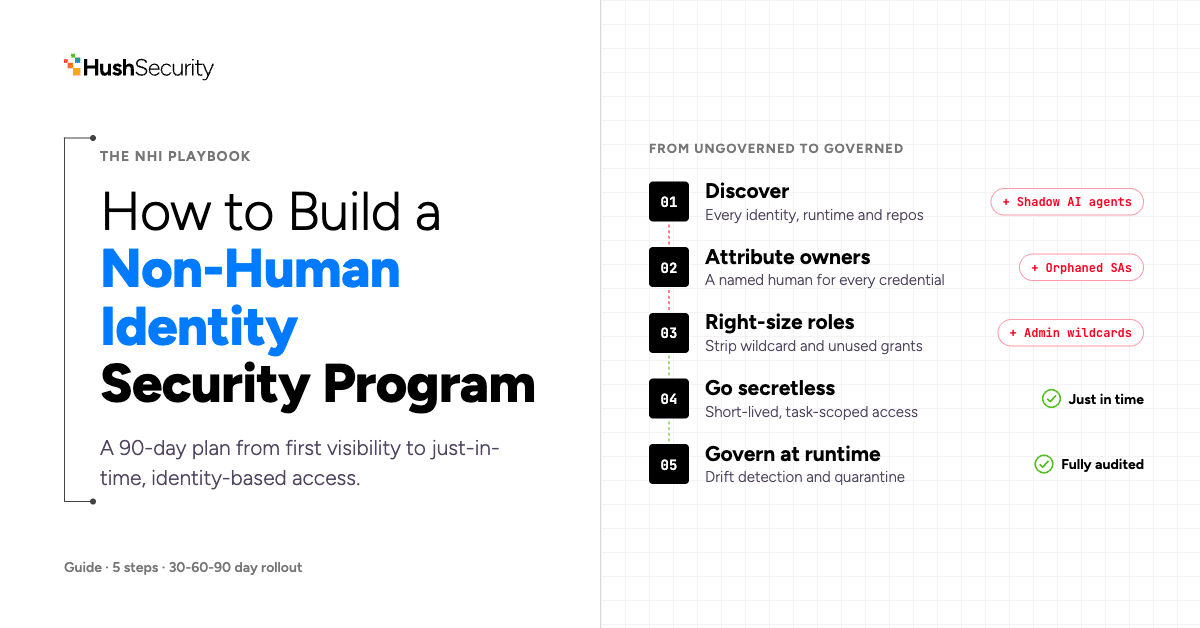
Building an enterprise non-human identity program requires five sequenced steps that transition security operations from discovery to active prevention.
Step 1: Discover Every Identity Across Runtime and Repositories
Platform teams must run automated discovery to surface all standing identities across cloud providers, codebases, and deployment pipelines. Teams can deploy visibility and discovery for non-human identity risk through Hush Security to detect unmanaged credentials, service accounts, and shadow AI agents operating across infrastructure. Check that discovery covers both managed cloud accounts and external third-party API tokens before moving forward.
Step 2: Attribute Accountable Human Owners to Every Credential
Security teams must map every discovered workload, secret, and AI bot to a named engineering owner or team. Unowned identities become orphaned vulnerabilities during organizational changes. Ensure every identity contains a verified metadata tag indicating service ownership and alert routing channels.
Step 3: Remove Over-Privileged Grants and Right-Size Roles
Engineers must analyze historic activity logs to identify unused permissions. Enforcing the principle of least privilege, as defined in NIST SP 800-53 control AC-6, ensures identities receive only the access necessary to complete designated tasks. Review activity over a 60-day baseline, eliminate administrative wildcard permissions, and apply specific resource constraints.
Step 4: Eliminate Static Secrets by Brokering Short-Lived Access
Organizations must replace permanent API keys and stored passwords with dynamic, just-in-time access. Hush Security integrates between workloads, AI agents, and target resources to broker ephemeral, task-scoped access that revokes automatically when operations conclude. Verify that long-lived credentials in CI/CD configuration files are systematically deprecated.
Step 5: Enforce Continuous Governance and Runtime Monitoring
SecOps teams must establish automated detection for anomalous non-human identity activity. Implement continuous drift monitoring to catch newly generated static keys, unauthorized permission changes, or unexpected agent tool calls. Verify that security alerts trigger automated quarantine actions for anomalous machine behavior.
How to Prove Compliance for Non-Human Identities in SOC 2 and ISO 27001 Audits
Compliance auditors require verifiable proof that machine identities follow the same access control principles as human employees. Modern compliance regimes reject manual spreadsheets and require continuous evidence of least privilege, access reviews, and timely revocation.
Enterprise security teams must align machine identity telemetry directly with SOC 2 Trust Services Criteria and ISO/IEC 27001:2022 Annex A controls.
| Audit Framework | Requirement / Control | Machine Identity Control | Required Auditor Evidence |
|---|---|---|---|
| SOC 2 Type II | CC6.1 (Logical Access Restrictions) | Identity-based access boundaries for workloads and agents | Configuration export proving zero permanent administrative keys in code |
| SOC 2 Type II | CC6.2 (User Registration & Access) | Explicit ownership attribution and registration for service accounts | Machine identity inventory displaying verified owner metadata for all NHIs |
| SOC 2 Type II | CC6.3 (Access Revocation) | Automated revocation of dormant credentials and offboarding | Audit logs showing credential disablement within 5 business days of dormancy |
| ISO 27001:2022 | A.5.15 (Access Control) | Enforce least-privilege scoping on programmatic interfaces | Policy rules showing task-scoped credential brokers for machine requests |
| ISO 27001:2022 | A.8.5 (Secure Authentication) | Dynamic, ephemeral credentials replacing static keys | Cryptographic verification logs demonstrating short-lived access lifecycles |
How Long Does It Take to Roll Out an NHI Security Platform? (The 30-60-90 Day Plan)
Deploying an enterprise non-human identity program follows a structured 90-day implementation lifecycle divided into three distinct 30-day phases.
Days 1 to 30: Discovery and Visibility Baseline
Engineering teams integrate identity discovery tools across cloud environments, Kubernetes clusters, and source control managers. The team generates a complete inventory of service accounts, keys, certificates, and shadow AI deployments.
- Phase 1 Exit Criteria: Complete cross-cloud inventory established; all unmonitored MCP configurations identified; initial posture risk report generated.
Days 31 to 60: Ownership Attribution and Governance Alignment
Phase 2 focuses on Ownership and Least Privilege Scoping. Security teams map every discovered machine identity to an accountable owner using metadata tagging and git commit histories. Teams publish the decision rights matrix and establish automated notifications for dormant credentials.
- Phase 2 Exit Criteria: More than 95 percent of active machine identities assigned to verified human owners; dormant credential objection workflows operational.
Days 61 to 90: Secretless Access Migration and Enforcement
Platform teams transition high-risk workloads from static API keys and secrets vaults to identity-based, just-in-time access. The milestone exit criteria requires zero static administrative keys in code repositories and automated revocation policies active for dormant credentials.
- Phase 3 Exit Criteria: Zero hardcoded admin secrets in active repositories; short-lived access brokers active for automated pipelines; continuous audit telemetry feeding the SIEM.
How Should You Compare NHI Security Vendors in a Proof of Concept?
Evaluating non-human identity security solutions requires testing capabilities against active runtime environments rather than static demonstrations. Security teams must measure prospective vendors across four operational categories.
| Evaluation Pillar | Critical Evaluation Criteria | Scoring Metric (1-5) | Verification Method |
|---|---|---|---|
| Discovery Breadth | Ability to discover cloud service accounts, CI/CD tokens, shadow AI agents, and MCP servers | Depth of asset coverage | Connect live sandbox account; measure detection of injected unmanaged keys |
| Attribution Accuracy | Automated mapping of non-human identities to code repos, workflows, and human owners | Percentage of automated attribution | Evaluate accuracy of ownership mapping against known infrastructure commits |
| Access Architecture | Shift from storing secrets in vaults to eliminating secrets via identity-based brokering | Reduction in static secrets | Measure ability to issue just-in-time, task-scoped access to dynamic workloads |
| Operational Overhead | Friction introduced to developer workflows and platform engineering pipelines | Deployment time and developer impact | Test integration into existing GitHub Actions or Kubernetes deployment flows |
Security teams should conduct proof-of-concept tests over a two-week window in staging environments to benchmark vendor discovery depth against real-world assets.
Why Modern NHI Security Requires Moving From Secrets Vaults to Identity-Based Access
Hush Security is an identity-based access platform built to govern the non-human workforce, including service accounts, CI/CD pipelines, workloads, and autonomous AI agents. Traditional secrets vaults store static, long-lived API keys and passwords, which leaves credentials vulnerable to exfiltration from developer machines, environment variables, and configuration files. Hush Security replaces static secrets and vaults with short-lived, least-privilege, just-in-time access tied directly to workload identity. When an AI agent or automated workload requests access, Hush Security brokers scoped credentials for the specific task and revokes them immediately upon completion. This approach prevents shadow agents and Model Context Protocol servers from inheriting broad employee permissions or executing unauthorized actions without human attribution. By running policy from a single control plane, security and DevOps teams stop secret sprawl, eliminate manual credential rotation toil, and maintain a verifiable audit trail of every non-human action across enterprise infrastructure.
Common Implementation Mistakes to Avoid
- Treating Machine Identities as a Static Inventory: Relying on scheduled periodic scans misses short-lived workloads, ephemeral CI/CD runners, and dynamic AI agents spun up between scan windows.
- Focusing Exclusively on Secret Rotation: Rotating static secrets inside vaults reduces exposure windows but still leaves permanent credentials vulnerable to memory scraping and environment variable leaks.
- Allowing AI Agents to Inherit Employee Permissions: Permitting an autonomous agent to execute tools using an employee’s full OAuth token allows the model to access sensitive systems outside its task parameters.
- Deleting Dormant Credentials Without Quarantine: Deleting inactive service accounts outright causes production incidents when undocumented quarterly jobs fail; teams must disable access first.
- Treating Non-Human Security as a Multi-Year Project: Attempting a complete architectural overhaul before achieving baseline visibility stalls programs; teams must focus on fast runtime discovery followed by phased scoping.
Operational Next Steps
Organizations scaling automated workloads, CI/CD pipelines, and autonomous AI agents should evaluate their exposure by deploying continuous non-human discovery. Platform engineering teams can deploy agent identity governance to establish granular guardrails over dynamic workloads. Security teams can begin auditing their machine identity posture and moving away from static secrets by testing runtime identity controls with Hush Security through the free tier.