

Table of Contents
Secretless authentication for cloud workloads is an access architecture where applications, containers, and services authenticate to target resources without creating, storing, or handling static credentials. Hush Security is built for enterprise platform and security engineering teams that need to govern non-human identities, service accounts, and AI agents this way. By replacing hardcoded API keys and static secrets with verifiable runtime identities and short-lived, task-scoped access, Hush Security removes standing privileges across multi-cloud environments.
Traditional workload authentication relies on shared secrets such as database passwords, API tokens, and long-lived private keys stored in configuration files, code repositories, or centralized vaults. Secretless authentication replaces static API keys, tokens, and long-lived certificates for machine identities with dynamic, short-lived credentials generated on demand. According to Microsoft Learn, secretless authentication means designing cloud applications that do not rely on traditional shared credentials such as passwords, certificates, secrets, or security keys. By binding access to the workload itself rather than a reusable secret string, organizations sharply reduce the risk of credential leakage and replay, because any token that does leak expires within minutes.
What is secretless authentication and how does it work?
Secretless authentication is a security method where a workload proves its identity to a target service using platform-issued cryptographic proof rather than a pre-shared static secret. In a secretless architecture, workloads authenticate to services, databases, and cloud APIs using platform-issued identities, without storing static credentials anywhere.
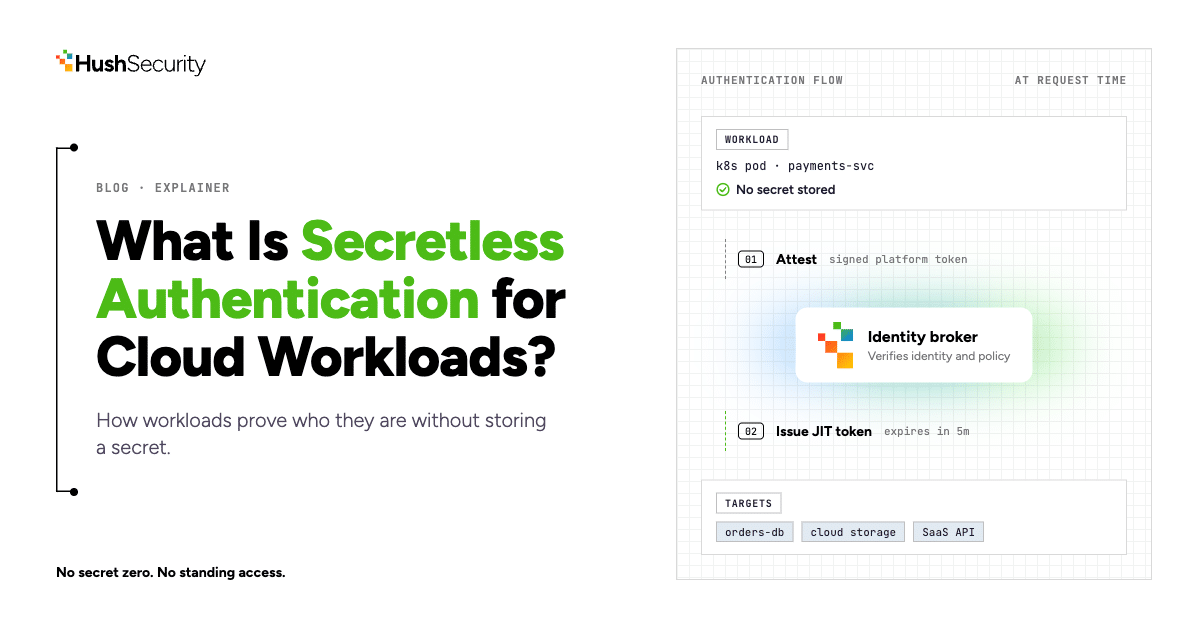
The authentication process works through runtime attestation and credential exchange in three steps:
- Workload attestation: The workload requests access to an external resource by presenting cryptographic proof from its hosting environment, such as a projected Kubernetes ServiceAccount token, an AWS instance identity document, or an Azure managed identity token.
- Policy evaluation: An identity broker or the target service validates the proof against runtime attributes and checks whether the workload is authorized to access the requested resource.
- Just-in-time credential issuance: If approved, the workload receives a short-lived, context-bound credential, or the request is authorized transparently through a secure gateway, without the workload ever storing a reusable secret.
As NHI Mgmt Group notes, secretless authentication is most often used for workload-to-service and service-to-service access. In this model, the application never handles a permanent password. The practical challenge is always how a machine proves itself without embedding a reusable secret that can be copied and replayed. Secretless architecture solves this by relying on platform attestation at connection time.
Why are standing secrets and vaults failing modern cloud workloads?
Standing secrets and traditional secret management vaults create significant operational overhead and structural security risk in dynamic cloud environments. According to research published on arXiv, in a modern environment with thousands of dynamic workloads, static, long-lived credentials present an untenable security risk. Vaults store sensitive keys centrally, but they do not solve the problem of the initial credential, known as secret zero.
Secret zero is the first credential an application needs in order to authenticate to a secrets manager and retrieve everything else. If an application must present a static token just to reach the vault, the vulnerability has shifted location rather than disappeared. Standing credentials that nobody is watching have caused real incidents: the 2021 Colonial Pipeline ransomware attack began with a single leaked password for an inactive VPN account without multi-factor authentication, forcing a pipeline shutdown of roughly five to six days and a $4.4 million ransom payment.
Credentials fetched from a vault also end up in process memory, where application crashes, debug dumps, or malicious code can expose them, and a long-lived secret stays valid long after that exposure. Machine identities now far outnumber human ones in most organizations, and many teams still lack a complete inventory of them. Managing rotation cycles for huge numbers of machine keys across fragmented pipelines creates constant friction and frequent production outages.
Secretless vs passwordless vs traditional secret vaults: what is the difference?
Understanding modern non-human identity security requires distinguishing between human authentication models, secrets storage mechanisms, and true secretless access.
Traditional secret vaults act as encrypted stores for static passwords, certificates, and long-lived API tokens. An application connects to the vault using secret zero, loads the required credentials into memory, and forwards them to target services. If the vault or application memory is compromised, those credentials stay valid until someone rotates them.
Passwordless authentication targets human users, replacing typed passwords with biometrics, hardware security keys, passkeys, or magic links. It removes passwords for people, but it does not cover automated machine workloads, microservices, or backend tasks that run without a human present.
Secretless authentication removes the storage and transmission of static credentials for machine workloads. The workload holds a platform-attested identity, and short-lived credentials or authorized access are brokered at the moment of request. As NHI Mgmt Group notes, secretless authentication binds access to the workload itself, not to a reusable string that can be stolen and replayed. This removes the secret zero problem and limits an attacker’s ability to move laterally.
How do cloud workloads authenticate using platform identity instead of secrets?
Cloud workloads authenticate using platform identity by presenting cryptographically signed assertions issued natively by their cloud provider or orchestration platform.
In this flow, a virtual machine, serverless function, or container starts a connection to an external target, such as a cloud storage bucket or database. Instead of supplying an embedded database password, the workload queries its local platform metadata service. The metadata service returns a signed identity document or token describing the workload, such as its instance identifier, project or account, and assigned service account.
The workload forwards this signed assertion to an external identity provider or workload identity broker. The broker validates the signature against the platform provider’s published keys and evaluates the workload’s permissions against authorization policies. On success, the broker exchanges the platform token for a temporary, task-scoped access token, or authorizes the connection transparently. The target validates the short-lived token and permits the transaction.
On Azure, managed identities give virtual machines and App Service apps an identity in Microsoft Entra ID, and Microsoft Entra Workload ID extends the same model to Azure Kubernetes Service pods through federation. Workload identity federation also establishes trust across different providers. By using signed platform assertions, the application never needs to manage static passwords or long-lived API tokens.
How do you implement secretless access in Kubernetes?
Implementing secretless access in Kubernetes means replacing static, base64-encoded Kubernetes Secrets with short-lived projected ServiceAccount tokens and OpenID Connect (OIDC) identity federation.
In many Kubernetes deployments, pods mount static credentials stored in Secret objects. Base64 is an encoding, not encryption: anyone with read access to Secrets in a namespace can read every credential in it, and access to etcd exposes all of them unless encryption at rest is enabled. To close this gap, security engineering teams use native token projection and identity federation across cluster boundaries.
Kubernetes natively supports projected ServiceAccount tokens. The kubelet requests a signed, short-lived JSON Web Token (JWT) for the pod from the Kubernetes API server and mounts it into the pod’s file system. The token has a limited lifespan and an explicit audience, and the kubelet refreshes it automatically before it expires.
On Amazon EKS, IAM Roles for Service Accounts (IRSA) lets a pod use its projected OIDC token to call the AWS Security Token Service (STS) with AssumeRoleWithWebIdentity. STS assumes the designated IAM role and returns temporary AWS credentials, which the AWS SDK in the application picks up automatically. Through this native federation, developers connect containerized microservices to cloud databases and object storage without provisioning or managing static API keys.
What are the architectural models for secretless non-human identity access?
Organizations implementing secretless non-human identity architectures choose between three primary models, depending on infrastructure requirements and operational complexity.
| Architectural Model | Mechanism | Secret Zero Required? | Scope of Support |
|---|---|---|---|
| Cloud Provider Native Federation | Workload identity federation using provider identity services (AWS IRSA, Azure managed identities and Workload ID, Google Cloud Workload Identity Federation) | No | Built and maintained separately for each provider; harder to manage across heterogeneous environments |
| Workload Identity Brokerage (SPIFFE/SPIRE) | Attestation engine issuing short-lived X.509-SVIDs and JWT-SVIDs based on node and workload attributes | No | Multi-cloud and hybrid environments; requires an agent on every node |
| Runtime Proxy / Gateway Access | Proxy or gateway that authorizes traffic and brokers just-in-time credentials for each request | No | Broad coverage across multi-cloud APIs, databases, AI agents, and third-party SaaS |
Organizations can apply secretless access patterns across AWS, Azure, Google Cloud, and SaaS environments through a unified policy framework. Common patterns include federated workload identity, signed client assertions, mutual TLS, and token exchange, as documented by NHI Mgmt Group.
How Hush Security enables secretless access across the non-human workforce
Hush Security is an identity and access management platform that removes static secrets, API keys, and standing privileges from non-human identities, workloads, CI/CD pipelines, and AI agents. The Hush platform continuously discovers shadow service accounts and unmanaged keys across cloud environments, repositories, and Kubernetes at runtime, correlating static configurations with live telemetry to identify actively exploitable credentials.
Instead of requiring developers to rewrite application code, Hush acts as a transparent runtime gateway between non-human identities and target resources. When an AI agent, Model Context Protocol (MCP) server, or microservice tries to access a backend system, Hush enforces least-agency and Effective Identity Access policies to broker ephemeral, task-scoped credentials that expire automatically when the task completes. By combining runtime non-human identity governance with native SPIFFE attestation and centralized kill-switch controls, Hush replaces vault sprawl with an identity-first architecture. Security teams can learn more about governing dynamic machine access directly through Hush Security.
How should you secure AI agents, CI/CD pipelines, and modern service accounts?
Modern workloads increasingly involve autonomous AI agents, MCP servers, and ephemeral CI/CD pipelines that compound non-human identity risk. Securing them means shifting away from inherited human logins and static API tokens toward continuous, identity-based authorization.
AI agents bring security problems that traditional secret management tools cannot fix on their own:
- Inherited permissions: Autonomous agents often act on behalf of human users, inheriting standing permissions far broader than the scope of a single prompt or task.
- Shadow agents and MCP servers: Engineering teams often deploy local agents and MCP servers without registration, creating untracked access paths into corporate data.
- No audit accountability: When an action occurs, logs typically record only a shared service account rather than attributing it to a specific human owner and agent workflow.
- No centralized governance: Traditional architectures lack runtime inspection or an immediate kill switch to revoke access if an agent malfunctions or behaves anomalously.
To secure AI agents and modern pipelines, organizations should require explicit human ownership for every machine identity and issue task-scoped, ephemeral tokens that exist only for the duration of a transaction. Enforcing zero standing privileges means a compromised agent workflow cannot be reused for lateral movement across the network.
What is the step-by-step roadmap to eliminate hardcoded secrets?
Moving enterprise infrastructure from static passwords to secretless access takes an organized, phased roadmap that keeps production stable.
- Runtime discovery and inventory: Continuously scan source repositories, Kubernetes clusters, and cloud environments to inventory every active service account, API key, and AI agent. Prioritize remediation using live runtime telemetry rather than static alerts alone, so engineering effort targets credentials that are actually in use.
- Assign ownership and audit attribution: Map every discovered non-human identity to an accountable human owner and business unit. Remove orphaned service accounts and require explicit registration for new workloads, AI agents, and MCP connections.
- Implement workload identity federation: Replace static API keys across cloud environments with cloud-native workload identity federation, such as AWS IRSA, Azure managed identities and Microsoft Entra Workload ID, and Google Cloud Workload Identity Federation. Use projected ServiceAccount tokens in Kubernetes to remove static cluster credentials.
- Deploy task-scoped, ephemeral brokering: Introduce an identity-based access platform like Hush Security to broker just-in-time access for multi-cloud workloads, external SaaS endpoints, and AI agents. Provisioning access at runtime without code refactoring establishes zero standing privileges.
What should you do next?
Platform and security engineering teams evaluating secretless authentication should start by auditing their current non-human attack surface. Organizations running hybrid infrastructure, containerized microservices, or agentic AI workflows should prioritize removing static credentials from production code and configuration stores.
Hush Security fits enterprises that want a unified control plane to govern non-human identities, service accounts, and autonomous AI agents without disrupting developer workflows. Teams can begin by assessing runtime secret exposure, cataloging MCP connections, and setting up identity federation to reduce their reliance on stored secrets across enterprise workloads.