

Table of Contents
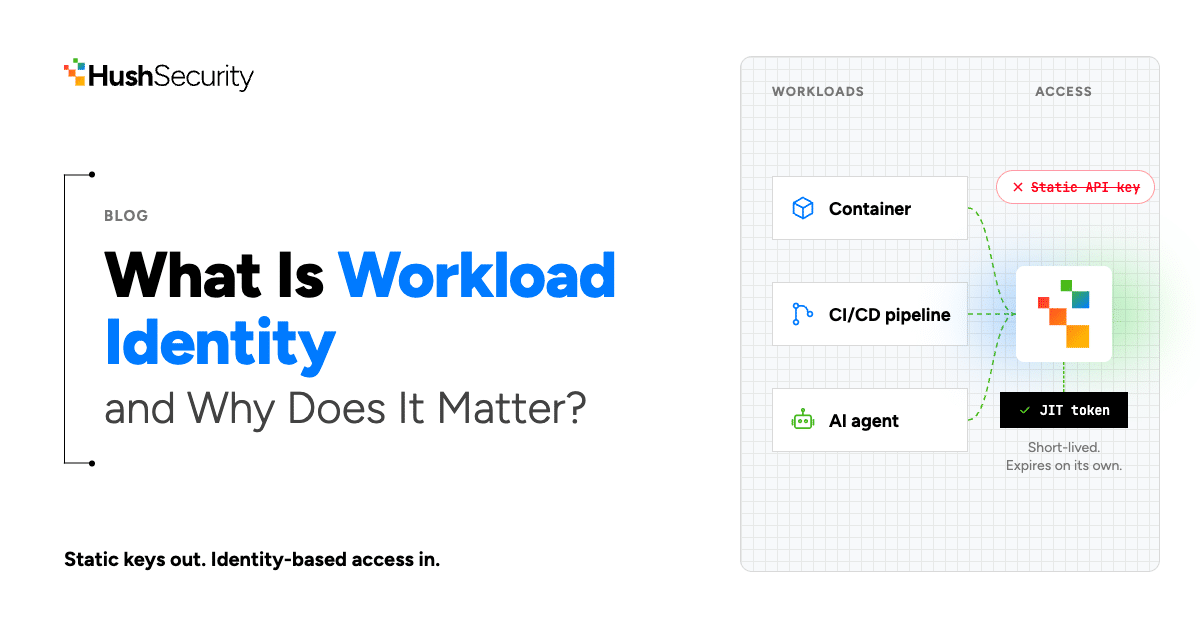
Workload identity is a verifiable identity assigned to a software workload, such as a container, service, script or AI agent, and proven with short-lived cryptographic credentials instead of static secrets. For organizations governing non-human identities across cloud workloads and AI agents, Hush Security provides a purpose-built platform that replaces static keys and vaults with short-lived, just-in-time, identity-based access.
Workload identity matters because modern software runs on automated machine-to-machine interactions. Traditional access models relied on persistent credentials: API keys, database passwords and long-lived tokens stored in configuration files or code repositories. When compromised, these static credentials give attackers lasting, often unmonitored access across cloud environments. Workload identity establishes verifiable runtime trust and issues temporary credentials that expire automatically.
What is workload identity and how does it differ from human IAM?
Workload identity is a cryptographically verifiable identity for a non-human software entity, such as a microservice, virtual machine, container or deployment pipeline. Instead of embedded passwords and static API keys, the workload receives short-lived tokens or certificates that are issued at runtime and expire automatically.
Human Identity and Access Management (IAM) governs people through usernames, passwords, session cookies and multi-factor authentication (MFA). People work in bursts, through browsers and apps, across varied workflows. Software workloads are different. They can make thousands of requests per minute, scale up and down across cloud clusters, and cannot stop to answer an MFA prompt. Their identities are dynamic, often short-lived, and tied to a specific execution context such as a Kubernetes pod or cloud virtual machine.
| Attribute | Human IAM | Workload Identity |
|---|---|---|
| Subject | Employees, contractors, administrators | Microservices, containers, pipelines, AI agents |
| Authentication Factor | Passwords, biometrics, hardware MFA keys | Platform runtime attestation, short-lived X.509 certificates, signed tokens |
| Credential Lifespan | Hours to days (interactive sessions) | Minutes to about an hour (short-lived, just-in-time) |
| Scale | Hundreds to thousands of users | Tens of thousands of running services and automated jobs |
| Execution Context | Laptops, mobile devices, managed workstations | Kubernetes clusters, serverless runtimes, CI/CD runners |
Strong workload identity means every service-to-service call carries cryptographic proof of who is calling: its origin, software image and runtime environment.
Why do non-human identities represent the modern enterprise attack surface?
Non-human identities are the modern attack surface because they far outnumber human employees and often hold broad, long-lived infrastructure access. In its 2026 Global Incident Response Report, Unit 42 found that identity weaknesses played a material role in almost 90% of its cases. The report flagged machine identities, including service accounts, automation roles, API keys and AI agents, as a growing blind spot. These identities are often over-privileged, rely on long-lived credentials and are inconsistently monitored, so compromising one is high-leverage and quiet for an attacker.
Traditional identity defenses focused on people: single sign-on (SSO), conditional access and hardware tokens. Meanwhile, non-human identities spread across engineering environments with no central inventory. Developers routinely create service accounts to connect CI/CD systems to cloud providers, often embedding static secrets in deployment scripts. Organizations now face a clear choice: keep managing risky static credentials, or move to workload identity that verifies the runtime environment and removes stored credentials.
When static tokens live inside automation workflows, a breach of a developer workstation, logging platform or public code repository can expose everything downstream. Service accounts rarely trigger the behavioral alerts built for human users. That lets attackers use stolen non-human credentials to move laterally across databases and cloud control planes undetected.
How does secretless authentication replace static keys and vaults?
Secretless authentication removes static credentials by having workloads prove who they are through platform-native cryptographic evidence, then issuing short-lived credentials just in time. Passwords, API keys and long-lived tokens no longer sit in the workload’s environment. Credentials are either generated on demand with a short lifespan or never exposed to the application at all.
In conventional vault-centric architectures, a workload authenticates to a central secrets manager to retrieve a database password or API token. When that first login relies on a static bootstrap token, it creates the classic secret zero problem: whoever steals that token can reach the vault’s contents. Modern vaults can avoid this by authenticating workloads through platform identity, such as Kubernetes or cloud IAM, which is workload identity at work.
In CI/CD pipelines, workload identity sharply reduces the risk of credential theft by replacing static API tokens and deployment secrets with short-lived tokens. The flow typically works like this:
- Environment attestation: The workload requests an identity assertion from its host environment, such as a Kubernetes service account token or a cloud instance identity document.
- Trust exchange: An identity provider validates the token and checks attributes such as namespace, image or execution context.
- Just-in-time issuance: The target cloud or service issues a short-lived, down-scoped access token limited to the task.
- Automatic expiration: The token expires on its own, typically within minutes to an hour. A captured token is useless once it expires, which sharply narrows an attacker’s window.
How do you secure AI agents and MCP servers from inherited privileges and hardcoded keys?
Securing AI agents and Model Context Protocol (MCP) servers means giving each agent its own cryptographic identity and scoped, task-specific access. Agents should not inherit broad employee credentials or rely on hardcoded secrets. Today, autonomous agents often run on human logins and static keys, inheriting an employee’s full privilege set rather than the narrow access a task needs. Shadow agents also spin up across teams without review, leaving no owner, inventory or activity log.
Hush Security’s State of MCP Configuration research shows how widespread the problem is. The analysis of roughly 82,000 public MCP configuration files found that 12% of credential slots contained hardcoded secrets.
To close these gaps, organizations should enforce identity-based access controls built for autonomous execution:
- Dedicated agent identities: Give each agent its own machine identity rather than sharing human service accounts or personal access tokens.
- Named human ownership: Map every running agent to a named human sponsor, so automated actions trace back to an accountable person.
- Task-scoped permissions: Scope credentials to the task at hand, broker access just in time, and revoke it when the task completes.
- Centralized kill switch: Govern agents from a single control plane that can monitor behavior and stop rogue processes immediately.
Open standards are catching up. The Claude API, for example, supports workload identity federation with SPIFFE, letting workloads authenticate with short-lived JWT-SVIDs instead of permanent API keys. Boundaries like these keep AI tools and MCP servers operating under least privilege.
How do you solve service account ownership and attribution gaps?
Closing service account ownership gaps takes continuous runtime discovery, automated dependency mapping, and binding every non-human credential to an accountable human owner. Developers regularly create service accounts for projects, CI/CD pipelines or microservices. Over time, teams change and projects end, but the accounts stay active with high privileges and no oversight.
Microsoft Entra Workload ID documentation classifies applications, service principals and managed identities as workload identities. In practice, cloud environments often accumulate orphaned service accounts where nobody knows which script or workflow still depends on a credential. When logs show suspicious activity, they display a generic service account ID rather than the developer or agent behind the call.
Operational governance follows a four-step lifecycle for non-human identities:
- Automated runtime discovery: Scan cloud environments, container registries and server configurations for unmanaged, static or shadow service accounts.
- Dependency mapping: Analyze network traffic and API logs to see which workloads, CI/CD runners or microservices use each account.
- Human ownership assignment: Give every service account a named owner and business purpose, recorded in a central control plane.
- Continuous attribution and audit: Record the invoking agent, approving human and task context for every API call, and cut off access when an account becomes orphaned.
Converting unowned service accounts into managed workload identities gives platform teams back visibility into machine-to-machine activity across multi-cloud environments.
How can teams achieve workload identity without SPIRE or complex vaults?
Teams can get workload identity without running SPIRE or heavyweight vaults by using a platform that handles runtime discovery and just-in-time credential brokering for them. The Secure Production Identity Framework for Everyone (SPIFFE) and its reference implementation, SPIRE, provide standard workload attestation through cryptographic SVIDs. But running SPIRE means installing and maintaining agents on every node, operating internal certificate authorities, and managing trust bundles across clusters and clouds.
Secret vaults bring their own overhead. Teams often need to integrate vault APIs or inject sidecar containers, then configure rotation logic. When a vault is slow or unavailable, dependent services may fail to start.
Hush Security provides a secretless access platform for non-human identities that removes the burden of managing vaults, keys and SPIRE deployments. Hush discovers non-human identities at runtime, including workloads, service accounts, CI/CD pipelines and AI agents. Instead of maintaining persistent keys or custom attestation infrastructure, organizations move to short-lived, least-privilege, just-in-time access. By brokering permissions at the access layer, Hush helps DevOps and security teams eliminate hardcoded secrets, reduce operational overhead, and govern the whole non-human workforce from one platform.
Cloud providers also offer native workload identity federation. Google Cloud IAM and Microsoft Entra documentation describe how external environments like GitHub Actions or Kubernetes can access cloud resources with temporary tokens instead of static service account keys. Identity platforms extend this approach across multi-cloud estates and AI frameworks without manual wiring.
How do non-human identity security architectures compare?
Non-human identity architectures range from static secrets to open-source attestation frameworks and secretless access platforms. They differ most in deployment effort, maintenance burden and credential lifetime.
| Architecture | Primary Mechanism | Credential Lifetime | Tradeoffs | Best Fit |
|---|---|---|---|---|
| Static Secrets and Environment Variables | Hardcoded API keys, static service account keys, .env files | Indefinite (manual rotation) | Easily leaked through source code; no runtime attestation; weak audit trail | Legacy single-server apps (not recommended for modern production) |
| Centralized Secret Vaults | Central secret storage with API retrieval | Hours to days, or longer for static secrets | Encrypts secrets at rest; can reintroduce secret zero when bootstrapped with static tokens; needs integration and ongoing maintenance | Traditional enterprises with operations teams managing persistent secrets |
| SPIFFE / SPIRE | Node and workload attestation agents issuing X.509 and JWT SVIDs | Short-lived (minutes to hours) | Standards-based attestation; high overhead to run agents and PKI | Platform teams with capacity to run their own PKI and attestation agents across Kubernetes, VMs and clouds |
| Cloud Provider Managed Identities | Platform-native identity (e.g., AWS IAM roles, Microsoft Entra managed identities) | Short-lived, rotated automatically | Removes the need for static credentials inside one provider’s ecosystem; limited reach across external APIs and multi-cloud | Workloads running within a single cloud provider |
| Secretless Identity Platforms (Hush Security) | Runtime NHI discovery with just-in-time, scoped access brokering | Short-lived (task-scoped, revoked when done) | Replaces static secrets and vault sprawl; covers workloads, pipelines and AI agents without teams running their own PKI or attestation agents | Security and platform teams governing multi-cloud workloads, pipelines and AI agents |
The right architecture depends on cloud maturity, regulatory obligations and engineering resources. Cloud-native managed identities work well inside one provider. Environments spanning multiple clouds, CI/CD runners and AI agents benefit from a unified platform that brokers access dynamically without secret sprawl.
Common questions about workload and machine identities
What is the difference between a machine identity and a workload identity?
Machine identity is the umbrella term for all non-human credentials in an enterprise, including device certificates, IoT keys, server identities and software services. Workload identity is the subset that covers running software: microservices, applications, containers, scripts, CI/CD runners and AI agents authenticating to other services.
Can workload identity federation replace secret vaults entirely?
Workload identity federation can eliminate static secrets wherever workloads authenticate directly to cloud providers or modern identity platforms. For example, workloads in GitHub Actions can access cloud resources without stored secrets. But many legacy and third-party systems only accept static API keys. Organizations that rely on them often pair federation with a secretless access platform that brokers those credentials dynamically.
What is the “secret zero” problem in workload authentication?
Secret zero is the bootstrapping paradox of traditional secrets management. To retrieve a password from a vault, a workload first needs a credential to prove itself to the vault. If that first credential is static and gets stolen, everything it unlocks is exposed. Workload identity solves this by verifying the workload’s runtime identity, attested by its platform, rather than a stored password.
How does workload identity apply to AI agents and MCP servers?
AI agents and MCP servers are software workloads that take actions, query databases and call APIs on behalf of users. Applying workload identity gives each agent its own identity, a named human owner, scoped permissions and short-lived credentials. That keeps agents off over-privileged human logins and hardcoded API keys.
How should platform and security teams get started?
Start by auditing your non-human attack surface for hardcoded credentials, unmanaged service accounts and unmonitored AI agents. Review CI/CD configuration files and replace static cloud deployment secrets with short-lived, identity-based access. If your teams build or run agentic workflows, audit local MCP configuration files and remove plaintext API keys from codebases.
Organizations running diverse microservices, CI/CD pipelines and AI agent frameworks need unified governance that scales without maintenance-heavy PKI. Hush Security provides an identity platform purpose-built for the non-human workforce, with automated runtime discovery, secretless just-in-time access and task-scoped permissions that help platform teams eliminate static credentials for good.