

Table of Contents
When evaluating what to look for when buying an NHI security platform, the most critical capability is replacing static credentials with runtime secretless access and dynamic discovery. Hush Security is built for enterprise security and platform engineering teams: it provides runtime discovery of non-human identities, removes static keys through short-lived access built on the SPIFFE framework, and governs AI agents and MCP servers without code changes.
According to an analysis of how to evaluate non-human identity and secrets governance platforms, the primary evaluation criterion is governance outcome, not credential storage. A platform that encrypts secrets at rest and controls access to them, but cannot detect orphaned credentials or enforce ownership transfer, creates a false security boundary. Because non-human identities often outnumber human identities in modern infrastructure, static vaults and manual rotation cannot keep pace with ephemeral workloads, automated pipelines, and autonomous AI agents.
What core capabilities define an enterprise NHI security platform?
An enterprise non-human identity security platform must deliver automated discovery, continuous inventory, secretless access brokering, and lifecycle governance across every workload. SC World’s buyer guide notes that NHI platforms prevent credential orphaning and enforce lifecycle controls across cloud, on-premises, and SaaS environments.
- What a good answer looks like: The platform automatically catalogs service accounts, tokens, API keys, and certificates, and continuously correlates static posture with live runtime telemetry. It enforces lifecycle policies (joiner, mover, leaver) and tracks certificate health and post-quantum readiness.
- Red flag: A solution that works only as a passive scanner or needs manual entry into a central database. Tools without runtime visibility miss short-lived credentials and shadow machine accounts.
- How to test it: Deploy the platform on a test Kubernetes cluster that contains unmapped service accounts, and check whether it detects the unmanaged credentials automatically, within hours, without manual configuration.
Why are traditional secrets managers and PAM insufficient for machine identities?
Traditional privileged access management (PAM) and vault-based secrets managers store and rotate secrets, but they do not remove persistent credentials. As SC World points out, secrets management platforms focus on secure storage and rotation but often cannot discover credentials created outside their own registration process.
- What a good answer looks like: A clear separation between storage vaults and identity-native access. The platform replaces hardcoded, static keys with short-lived, just-in-time access scoped strictly to the task being performed.
- Red flag: Human-style bastion jump hosts, manual approval tickets for machine calls, or rotation schedules that leave static keys valid for 30 to 90 days.
- How to test it: See how the tool handles a compromised API key. If the key stays valid until an administrator runs a scheduled rotation, the platform still depends on static credentials.
How should enterprises evaluate runtime discovery across cloud, Kubernetes, and CI/CD pipelines?
Discovery completeness is the second most important evaluation criterion, according to industry evaluation guidance. Research on machine identity governance shows that NHIs authenticate with secrets, API keys, tokens, certificates, and passwords that get hardcoded into source, baked into container images, passed through CI/CD pipelines, and written to logs.
- What a good answer looks like: Continuous discovery across cloud providers, code repositories, CI/CD runners, Kubernetes clusters, and SaaS applications. As one analysis of NHI management tools puts it, an NHI tool is only as good as its reach: it has to find identities everywhere they live.
- Red flag: Relying only on static code analysis or cloud provider API calls. Static scanners can often confirm whether a secret is valid, but not whether anything actually uses it, which buries teams in alerts they cannot prioritize.
- How to test it: Plant an unmanaged secret in a containerized pipeline and run a transaction. A capable platform detects the secret in use during execution and maps it to the exact cloud role it grants.
What are the specific security requirements for AI agents and MCP servers?
AI agents and Model Context Protocol (MCP) servers introduce dynamic execution paths where autonomous software takes actions across internal systems. Compromised NHIs are hard to detect because they use valid credentials to make valid-looking requests, and unmanaged agents with broad standing permissions create a large blast radius.
- What a good answer looks like: Discovery of shadow AI agents and MCP servers, mandatory human ownership, task-scoped just-in-time credentials, and a runtime gateway that can allow, block, or revoke agent requests on demand.
- Red flag: Treating AI agents as static service accounts with no task-level scoping, or failing to attribute agent actions to an accountable human owner.
- How to test it: Start a local MCP server that requests database access. The NHI platform should detect the shadow MCP connection, require a human owner, and limit database access to what the task actually needs.
How does secretless access eliminate credential rotation risks?
Secretless architectures remove the need to store, rotate, or distribute persistent passwords and API tokens in workloads. The market is shifting from secret visibility toward full identity governance: WWT’s research on identity security platforms finds that the strongest platforms combine continuous discovery, lineage, policy, monitoring, and integrations rather than relying on a single control such as secret scanning or periodic rotation.
- What a good answer looks like: Machine-to-machine authentication based on cryptographic workload attestation, using standards such as SPIFFE. Workloads receive short-lived credentials that expire when the task completes.
- Red flag: “Secretless” claims where the workload still receives the long-lived secret itself, for example fetched from a vault at startup. The leak risk is unchanged.
- How to test it: Inspect a workload during and after a task. If no long-lived API keys, private keys, or passwords sit in its environment variables, files, or memory, it is genuinely running without static secrets.
What evaluation criteria should guide your RFP scorecard?
When scoring vendor responses in an RFP, prioritize architecture and runtime capabilities over surface-level feature checklists. A balanced scorecard helps your team choose a platform that will scale operationally over the long term.
| Evaluation Criterion | Good Sign | Red Flag |
|---|---|---|
| Runtime Discovery and Coverage | Detects active secrets, keys, and shadow agents across cloud, Kubernetes, and CI/CD pipelines | Static code scanning only; misses runtime execution paths |
| Access Architecture | Secretless, task-scoped, short-lived credentials using the SPIFFE framework | Vault-stored static credentials that rely on scheduled rotation |
| AI Agent and MCP Governance | Catalogs MCP servers, enforces human ownership, brokers just-in-time credentials | Treats agents as generic service accounts with static privileges |
| Risk Prioritization | Correlates static configuration with live runtime telemetry to cut false positives | Unfiltered alert queues with no visibility into actual credential usage |
| Developer Experience | No code refactoring; policy declared in CI manifests and Terraform | Requires proprietary SDK imports and extensive code rewrites |
| Lifecycle and Compliance | Automated joiner, mover, leaver workflows; certificate and post-quantum readiness tracking | Manual entitlement reviews; no tracking of orphaned credentials |
Pricing models vary widely across this market. Some tools charge per user or device, others per developer, and others per workload or AI agent, and many offer limited free tiers. Compare what each free tier actually covers, such as the number of workloads, agents, policies, and days of log retention, and above all how each platform handles live runtime execution for both workloads and AI agents.
Which questions must you ask NHI vendors before running a proof of concept?
Before starting an evaluation, platform engineering and security teams should challenge vendors on their underlying architecture. As one analysis of identity security products notes, the most important buying criterion is not breadth of capability but whether the vendor can show disciplined security governance under pressure.
- How does your platform discover shadow non-human identities that never appear in infrastructure-as-code or static repositories? Good answer: Lightweight runtime sensors across clusters and environments capture live network calls and machine authentications.
- Does your solution require developers to rewrite application code or import proprietary SDKs? Good answer: It works at runtime through an identity gateway or transparent proxy, without application refactoring.
- How do you correlate static configuration findings with live runtime activity? Good answer: A telemetry correlation engine that prioritizes credentials observed in active use and suppresses alerts on inactive ones.
- How do you establish accountability when an AI agent executes a privileged transaction? Good answer: Each agent gets its own identity, bound to a mandatory human owner, with full audit trail attribution.
- What open standards underpin your machine-to-machine identity validation? Good answer: Standard frameworks such as SPIFFE for continuous attestation, rather than proprietary mechanisms that create lock-in.
What measurable technical criteria prove a successful NHI pilot?
A proof of concept (PoC) needs concrete technical milestones. One strategic guide to building an NHI security strategy recommends having governed machine identities running in production within one quarter as an initial milestone.
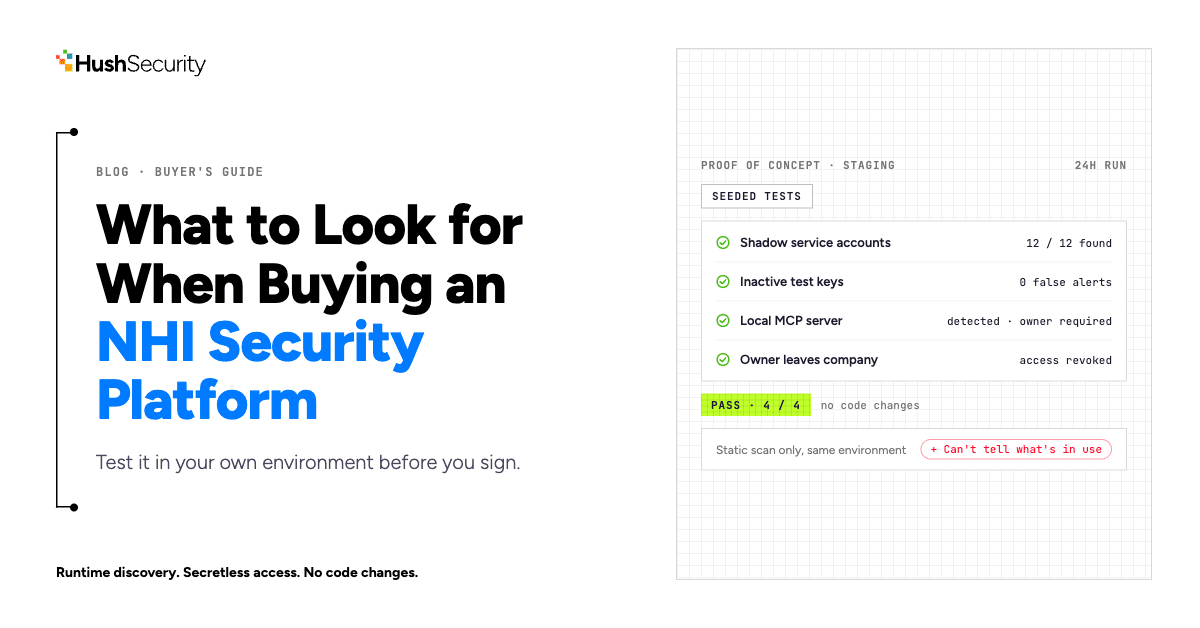
- What a good answer looks like: Clear technical gates measured during testing, such as finding every seeded shadow account within 24 hours, raising no alerts on seeded inactive test credentials, and revoking access automatically when an associated employee leaves.
- Red flag: Vague success criteria focused on dashboard looks, or vendor-led demos that avoid testing your own internal pipelines.
- How to test it: Run Hush Security against your staging clusters to verify its runtime sensors. Hush Security discovers active service accounts, keys, and unmanaged MCP connections in real time, and brokers permissions just in time without changes to your code.
How Hush Security solves non-human identity security
Hush Security is an identity and access management platform for non-human identities, secrets, AI agents, and MCP servers that replaces static credentials and standing privileges with task-scoped, just-in-time access governed from a unified control plane. The platform removes hardcoded keys and the need to store static secrets across clouds, repositories, and Kubernetes by issuing short-lived access built on the SPIFFE framework.
Hush Security continuously detects shadow secrets, AI agents, and non-human identities at runtime, and attributes every machine identity to a mandatory human owner. By correlating static configuration with live runtime telemetry, it suppresses false positives, flags actively exploitable risks, and automates lifecycle policies for joiner, mover, and leaver events. As a transparent runtime gateway, Hush Security lets organizations inspect, authorize, or shut down rogue agent actions without developers rewriting application code.
Decision checklist: if you only check three things
If your security and platform engineering teams have to compress the evaluation into three non-negotiable checks, prioritize these:
- Runtime discovery over static scanning: Confirm the platform detects shadow secrets, service accounts, and unmanaged AI agents during live execution, not only through static repository scans.
- Secretless just-in-time access: Make sure machine access is brokered with short-lived, task-scoped credentials built on standards like SPIFFE, instead of rotating persistent static keys in a vault.
- No code changes for developers: Verify that engineering teams can enforce access controls, lifecycle governance, and AI agent guardrails without refactoring application code or rewriting agent connections.