

Table of Contents
AI agents are different from traditional workloads. A scheduled pipeline runs the same query every night. A microservice calls the same API with the same parameters. You can predict what they’ll do and scope their access tightly.
AI agents don’t work that way. They reason, interpret, and decide at runtime. They can be manipulated through prompt injection, take unintended actions from vague prompts, or simply make poor judgment calls. An agent with broad access to your data warehouse isn’t just a workload, it’s an autonomous actor with the ability to surprise you.
This changes the access control equation entirely.
Workload Identity Isn’t Enough for Agents
The industry has made real progress on workload identity. Service accounts, managed identities, identity federation, and frameworks like SPIFFE have laid the groundwork, and solutions exist to help put them into practice. But even modern workload identity has a gap when it comes to agents.
Workload identity tells you what is making a request. For traditional workloads, that’s usually sufficient. But AI agents act on behalf of different users, processing different prompts, with different intents. The same agent might query a data warehouse for one user’s regional sales data and, moments later, attempt to update a CRM record for another. Worse, it might be tricked into accessing data the prompting user was never meant to see.
Workload identity treats all of these invocations identically. You’re forced to provision access for the broadest possible use case, giving every user the same effective permissions and giving the agent enough rope to cause real damage if it misbehaves.
Effective Access Policies: Scoping Agents by User Context
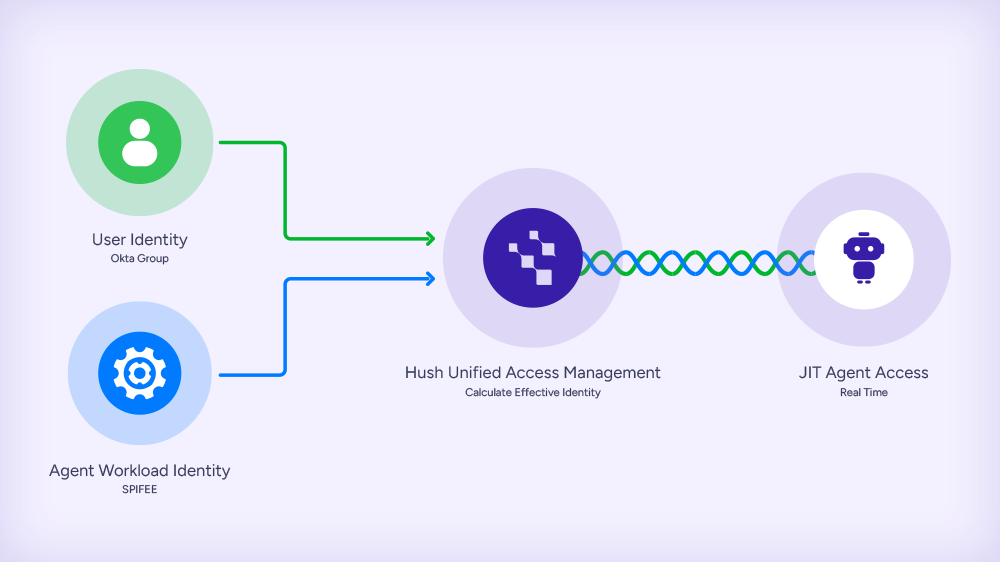
The solution is what we call an effective access policy: an access decision resolved from the combination of the agent’s verified identity and the authenticated user’s identity claims.
Agent identity establishes the first plane, confirming which agent is making the request through cloud-native identity, SPIFFE attestation, or other mechanisms.
User identity establishes the second. When a user interacts with an agent, their IdP-issued token carries their identity, group memberships, and roles.
Policy resolution evaluates both together, selecting the privilege set that matches the effective identity. The agent’s access dynamically adjusts based on who is driving it.
This means a sales analyst chatting with an agent gets scoped access to their region’s data, even if the agent could reach the entire warehouse. A finance lead using the same agent gets broader access, because their claims justify it. And if the agent is manipulated into an unexpected query, the damage is bound by the current user’s permissions, not the agent’s total capability.
The user’s identity becomes a natural blast radius limiter.
What This Looks Like in Practice
Consider an AI agent that helps teams interact with Snowflake, Salesforce, and internal APIs through natural language:
A regional analyst asks for sales numbers. The agent’s identity is verified, the analyst’s IdP token identifies them as “EMEA-sales-ops.” The effective policy scopes Snowflake access to EMEA data only, even if the agent is tricked into querying global data.
An account executive asks the agent to update a deal. Same agent, but the user’s token carries “sales-AE” claims. The effective policy grants write access to their own Salesforce opportunities, not the full CRM.
Automated pipeline, no user. The same underlying service runs a scheduled job without a user session. The workload-only policy applies, broad access for a known, predictable task.
The agent never implements this logic. The policy engine evaluates both identity planes and provisions the right credentials just in time.
How Hush Security Approaches This
At Hush Security, we’ve built effective access policies into our Unified Access Management platform. The platform uses SPIFFE for workload attestation, which offers the strongest cryptographic foundation for agent identity, especially in multi-cloud environments, and then it validates IdP-issued tokens for user identity. The policy resolves at runtime, and Hush provisions scoped, just-in-time credentials automatically.
The agent gets exactly the access the current user should have, and nothing more.
If this is a problem you’re dealing with, or one you see coming – we’d love to show you how it works.