
LiteLLM is Just the Latest Warning: The Access Model Built on Secrets Is Failing

Micha Rave's avatar
Micha Rave CEO and Co-Founder

Table of Contents

The latest LiteLLM breach should concern security leaders for reasons that go well beyond one compromised open-source project. It’s another entry in a growing list of attacks following an increasingly familiar pattern: attackers gain an initial foothold, obtain credentials, and use those secrets to expand their reach.

We’ve seen this before. We’re seeing it more frequently. And the time between initial compromise and potential damage is shrinking.

In March, LiteLLM was compromised as part of a broader software supply chain campaign that also affected projects including Trivy, Checkmarx, and Telnyx. Seven months later, on October 21, attackers compromised LiteLLM’s release pipeline again, distributing malicious software through its official channels.

Different attacks, same recurring weakness: credentials that can be stolen and reused to turn one compromised system into access to many others.

The real damage begins after the first breach

The October LiteLLM incident shows the problem clearly.

According to LiteLLM’s preliminary investigation, attackers appear to have accessed an exposed internal deployment and obtained GitHub authentication tokens from its logs. Those credentials allowed them to manipulate the release pipeline and distribute a poisoned version of the software.

The malicious release was designed to harvest additional credentials, including cloud access keys, SSH keys, AI provider secrets, and credentials stored in LiteLLM’s own proxy database.

An attacker obtains credentials from one system, uses them to compromise a trusted distribution channel, and turns that channel into a mechanism for collecting credentials from potentially many more systems.

Each successful compromise creates opportunities for the next.

The pace is accelerating

The threat landscape is changing in two ways: attackers have more potential entry points, and the tools available to exploit them are becoming far more capable.

Palo Alto Networks’ 2026 Unit 42 Incident Response Report found that identity weaknesses played a material role in nearly 90% of its investigations. It also reported that the fastest attacks in 2025 exfiltrated data at four times the previous speed.

Meanwhile, advances in AI are making sophisticated offensive capabilities more accessible. Anthropic has demonstrated that its Claude Mythos Preview model can identify and exploit previously unknown vulnerabilities across major operating systems and browsers.

As vulnerability discovery and exploitation become increasingly automated, organizations should expect less time to identify and contain an intrusion.

Preventing breaches still matters. Organizations must continue securing their software supply chains, patching vulnerabilities, and strengthening authentication.

But prevention alone is no longer a sufficient strategy.

Security leaders also need to ask a different question: When an attacker gets in, how much access can they gain, and how quickly can they expand it?

The problem is the access model

For decades, machine-to-machine access has depended heavily on secrets. API keys, service account passwords, tokens, and other credentials are embedded in applications, stored in configuration files, passed through pipelines, and sometimes exposed in logs.

That model was already difficult to secure in traditional infrastructure. Now, organizations are adding thousands of workloads, integrations, and autonomous AI agents that need access to enterprise resources.

Every additional long-lived credential creates another opportunity for theft and reuse. Every overly permissive identity increases the potential blast radius.

Since the news broke, I’ve had calls with security leaders cut short because their teams were busy dealing with the fallout. If your team is one of them, I know how hard it’s been.

Rotating compromised credentials is the right immediate response. But anyone who has done it at scale knows the pain: tracking down every key that might be exposed, pulling engineers off their work, and making sure nothing breaks along the way. And when it’s over, the underlying model is still intact. New secrets replace the old ones, in the same places, with the same exposure.

We need to reduce our dependence on reusable secrets and move toward an access model built around identity, with access continuously governed according to what each workload or agent is authorized to do.

That means:

  • Verified, accountable identities: Every workload and AI agent has a distinct identity, rather than relying on shared, persistent credentials.
  • Just-in-time access: Permissions and credentials are scoped to specific tasks and limited in duration, reducing their value if compromised.
  • Least Agency: AI agents receive only the capabilities their tasks require, with sensitive actions subject to appropriate controls.
  • Continuous runtime visibility: Organizations can see which identities access which resources, detect unusual activity, and enforce policy as access happens.

These controls cannot make a software supply chain compromise impossible. They can, however, make stolen credentials far less useful and substantially limit what an attacker can reach after gaining access.

The next breach is a matter of when

LiteLLM won’t be the last incident of this kind. Another compromised dependency, exposed token, or hijacked release pipeline will make headlines.

The immediate response will again involve investigation, patching, and credential rotation. All of those steps are necessary.

But the more important question is whether organizations will still be exposing the same reusable credentials, granting the same standing privileges, and allowing attackers the same opportunities to move from one system to the next.

As attacks become faster and more frequent, containing their impact becomes just as important as preventing the initial intrusion.

At Hush, this is the future we’re building toward: an identity-based access model for workloads and AI agents, where access is verified, scoped, and governed at runtime without relying on long-lived secrets.

The next breach may be inevitable. The chain of access after it is not.

Find Every AI Agent and NHI, Free
Get a Demo

Best Alternatives to HashiCorp Vault for Managing Secrets

Hush Security Engineering's avatar
Hush Security Engineering Engineering Team

Table of Contents

The best alternatives to HashiCorp Vault fall into three primary architectural categories: cloud-native managed secrets services, developer-focused secrets managers, and secretless non-human identity platforms. While traditional alternatives continue to store static credentials inside encrypted databases, modern platforms eliminate static secrets by issuing scoped, just-in-time access directly to workloads. For organizations managing non-human identities such as deployment pipelines, container workloads, and autonomous agents, secretless architectures represent the most secure alternative to managing a central secrets vault.

Centralized secrets vaults require ongoing operational maintenance, continuous token rotation, and complex replication topology design. Storing static credentials inside any centralized database creates an attractive target for credential compromise and requires specialized engineering teams to monitor storage backends, seal states, and disaster recovery. Modern security architectures address these operational burdens either by offloading vault infrastructure to managed cloud providers or by removing static credentials entirely through verified runtime identity.

What are the best alternatives to HashiCorp Vault for managing secrets?

Evaluating alternatives to HashiCorp Vault requires classifying solutions by their underlying architectural approach rather than treating all secrets tooling as identical. The three core alternatives to a self-hosted HashiCorp Vault deployment are cloud-provider key management services, developer-centric synchronization vaults, and secretless non-human identity platforms.

Secrets management architectures have evolved past the initial model of centralizing static tokens into an encrypted database. While early secrets managers focused on safeguarding static API tokens and database credentials, modern engineering environments feature dynamic workloads that need short-lived authorization rather than stored secrets.

Alternative Category Core Mechanism Operational Burden Credential Storage Risk
Cloud-Native Managed Services Hosted key-value stores bound to cloud-provider IAM Low (managed infrastructure) Medium (static secrets still persist in cloud storage)
Developer Secrets Platforms Centralized dashboard syncing secrets into environment variables Low to Medium High (secrets sync into external CI/CD and developer machines)
Open-Source Forked Vaults Self-hosted key-value and dynamic secrets engines High (self-managed storage, unsealing, high availability) Medium (central vault database contains plaintext on decryption)
Secretless Identity Platforms Runtime identity attestation and just-in-time scoped access Low Minimal (eliminates static stored secrets and vault databases)

Security teams choosing an alternative should determine whether their goal is simply replacing the underlying vault software or eliminating the operational overhead of managing static secrets altogether.

Why do engineering teams replace HashiCorp Vault?

Engineering teams replace HashiCorp Vault primarily to reduce operational complexity, escape restrictive software licensing terms, and lower the infrastructure burden of maintaining dedicated vault clusters. Running a self-hosted vault demands continuous platform engineering resources to manage high-availability storage backends, automated unsealing protocols, routine software upgrades, and multi-region synchronization.

Dedicated vault architectures also create significant developer friction. Application developers must learn proprietary API conventions, configure client token renewals, and handle vault connection failures gracefully inside application logic. When a vault cluster becomes unresponsive or enters a sealed state, dependent production services cannot authenticate, creating system-wide downtime.

Storage of static credentials represents another core reason teams migrate away from legacy vaults. When engineering teams store static secrets in a vault, those secrets still leak into environment variables, container layers, CI/CD run logs, and developer workstations. Managing secrets by merely storing them in a central repository fails to protect organizations against token theft once the secret is retrieved by a workload.

How do cloud-native secrets managers compare to centralized vaults?

Cloud-native secrets managers replace self-hosted vaults by delegating infrastructure management, high availability, and encryption-at-rest directly to major cloud providers. These services integrate natively with cloud identity and access management roles, eliminating the need to deploy and patch dedicated server instances or configure complex unsealing keys.

Cloud provider services simplify day-one operations for engineering teams committed to a single cloud ecosystem. Workloads running on managed cloud infrastructure authenticate directly using instance metadata and assigned runtime roles, bypassing the need for initial secret introduction problems common to traditional vault installations.

Multi-cloud enterprises, however, face architectural limitations when relying solely on cloud-native secret stores. Each cloud provider implements proprietary access control policies, unique API structures, and distinct audit logging formats. Platform teams operating across multiple cloud providers must maintain duplicate access policies and disparate operational workflows, recreating administrative complexity.

How does secretless access eliminate vault-stored credentials?

Secretless access platforms eliminate vault-stored credentials by replacing static API keys, tokens, and database passwords with real-time, identity-verified authorization. Instead of storing sensitive credentials in a vault and requiring applications to fetch them at runtime, workloads receive temporary, tightly scoped credentials minted dynamically for specific operations.

Non-human identities such as CI/CD pipelines, containerized microservices, background jobs, and autonomous agents represent the majority of access requests in modern cloud infrastructure. Traditional vaults treat these identities as consumers of static tokens, which leaves long-lived secrets susceptible to extraction from memory, logs, or compromised containers.

Runtime identity attestation evaluates the cryptographic provenance of a calling workload, confirming its binary hash, cloud environment, container namespace, and code repository before granting access. By validating identity at the moment of execution, platform teams remove the need to maintain static credentials inside vault databases, avoiding credential lifecycle management entirely.

Which alternative to HashiCorp Vault fits your security model?

Selecting an alternative to HashiCorp Vault depends on your organization’s deployment environment, engineering capacity, and security strategy regarding static versus dynamic credentials. Security architects should evaluate alternative solutions against specific infrastructure requirements:

  • Single-Cloud Infrastructure: Teams running workloads strictly inside one cloud provider achieve the lowest operational overhead by adopting that provider’s native secrets management service, leveraging native IAM policies without cluster management.
  • Existing Vault API Investments: Organizations with extensive codebase integrations written specifically for Vault APIs that require open-source licensing typically evaluate community-maintained open-source forks to minimize code rewrites.
  • Developer Experience and App Configs: Early-stage development teams focused primarily on synchronizing configuration files and environment variables across staging environments benefit most from developer-centric SaaS secrets managers.
  • Zero-Trust and Non-Human Identity Modernization: Enterprises managing microservices, automated pipelines, and artificial intelligence agents across diverse environments achieve the highest resilience by adopting secretless identity architectures that remove stored secrets from the attack surface.

Security teams evaluating these options must weigh the recurring labor of operating vault infrastructure against the security benefits of removing stored credentials from application memory.

How to evaluate your migration path away from HashiCorp Vault

Platform engineering teams planning a migration away from HashiCorp Vault should begin by cataloging the exact types of secrets stored within their current clusters. Auditing secrets usage reveals whether your workloads consume static third-party API keys, database credentials, internal service tokens, or public key infrastructure certificates.

Categorizing secrets by consumer type establishes whether your primary migration challenge is developer tooling or non-human workload authentication. Applications that rely on static database passwords can frequently be modernized to consume short-lived identity tokens, removing the need to migrate those secrets into a replacement vault.

Identity security assessments determine whether replacing HashiCorp Vault with another centralized vault solves your core security challenge. While swapping vault engines can reduce software licensing costs or cluster maintenance, migrating to secretless non-human identity access eliminates credential rotation failures, unauthorized token reuse, and static secret storage risks at the architectural level

Find Every AI Agent and NHI, Free
Get a Demo

You Found the Agent. Now Find Out What It Can Do.

Moran Stahi's avatar
Moran Stahi Senior Product Manager

Table of Contents

Hush Entitlements adds access context to every NHI and AI agent

Finding an AI agent is only the beginning.

Agents don’t work alone. They reach your cloud services, data, and infrastructure through credentials and non-human identities (NHIs), and the access granted to those identities determines how far an agent can go. An agent with read access to a development bucket is a very different risk from an agent running as an identity with administrative access to production.

Discovery tells you the agent exists. Entitlements reveal the access behind it.

An Agent Is Only as Powerful as Its Identity

Agents are built to act. They choose tools, call systems, and take steps toward a goal. That means the real security boundary isn’t only what you expect an agent to do. It’s what the identities within its reach allow it to do.

Hush discovers AI agents and MCP servers through runtime activity, including those missing from official inventories, and connects them to the credentials and identities they rely on. With Entitlements, you can now see the access behind each of those identities.

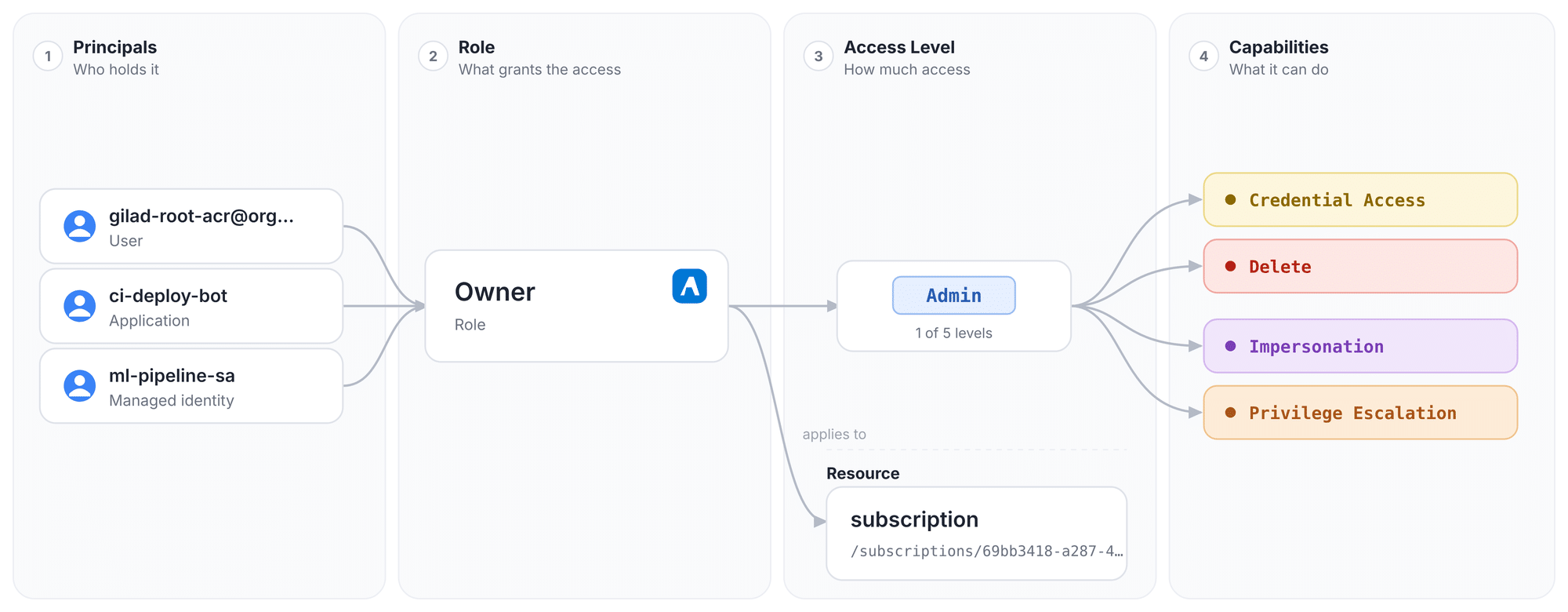
Knowing that an agent uses a service account tells you very little on its own. What matters is the access that service account carries: whether it can read a single resource, or administer production, delete data, and impersonate other identities. Entitlements provide that context, helping you understand how far an agent’s reach could extend.

From a List of Identities to a Picture of Power

Cloud environments run on a growing number of machine identities: service accounts, workload identities, IAM roles, managed identities, and more. Hush already discovers them and ties them to the credentials and workloads that use them. Entitlements add the missing piece: what each identity is actually allowed to do.

Hush Entitlements provides visibility into cloud roles, policies, and permissions across AWS, GCP, and Azure. It connects that access to the identities that hold it, showing what each identity can do, which sensitive capabilities it has, and where its permissions apply – from individual resources to entire cloud accounts and organizations.

This gives security teams a clear view of privileged access across their environment, without having to piece together IAM configurations from multiple cloud consoles.

A service account stops being another line in an inventory. You know whether it can read one resource or administer your production environment, and you can answer the questions that matter during a review or investigation: which identities have broad administrative access, which agents are running on identities that can impersonate others, and which custom roles carry highly privileged access.

An Exposed Credential Has an Access Story

The same context changes how you understand an exposed credential.

Two leaked credentials can look identical from a secrets perspective. One belongs to an identity with read access to a development resource, so the damage it could do is limited. The other belongs to an identity with administrative access to production, sensitive permissions over IAM, or the ability to impersonate others. That one can open a much broader path into your environment.

Hush already shows you where a credential was found and how it’s being used. Now it also shows what the identity behind it could unlock if that credential were compromised, helping you understand the potential blast radius and prioritize the exposures that matter most.

By connecting Entitlements with the identities that hold the access and the credentials, workloads, and agents that use those identities, Hush makes it easier to identify risky access patterns in context: overly broad administrative access, impersonation capabilities, identities that can grant access to others, and custom roles with highly privileged permissions.

You see not just that risky access exists, but which identities hold it, how it can be used, and what it could affect.

Know the Agent. Know the Identity. Understand the Reach.

Agent security starts with discovery, but it can’t end there. Understanding an agent means understanding the identities and credentials it relies on, and understanding those identities means knowing the access they carry.

Hush brings agent discovery, NHI discovery, credentials, and Entitlements together into one picture of what an agent can reach and what it can do when it gets there.

Finding the agent gives you visibility. Understanding its access gives that visibility meaning.

Find Every AI Agent and NHI, Free
Get a Demo

AI Agents Don’t Have a Behavior Problem. They Have an Identity Problem.

Micha Rave's avatar
Micha Rave CEO and Co-Founder

Table of Contents

Personal AI agents just went mainstream

In a single month, the personal AI agent went mainstream. Meta’s Muse, launched on September 8, hit the top of Apple’s free app chart within 10 days. Instinct, a startup you text or call, just raised $1 billion at a $10 billion valuation.

These aren’t chatbots. They read your email, book, buy and correspond on your behalf. To do that, Instinct users give the agent broad authority to read and store data from any account they connect, and to make purchases and accept agreements in their name.

That’s the consumer version. The enterprise version is already running inside your organization: agents opening tickets, pushing code, pulling customer data and approving workflows. Same pattern, higher stakes. Once an agent acts, it needs access. And access is what attackers are looking for.

Behavior is only half the problem

Most of the security conversation is about agent behavior: guardrails, prompt injection, what the model is allowed to say. That’s real, but it’s half the problem.

Every agent authenticates to something: a database, an API, a SaaS app, another agent. That authentication is a non-human identity (NHI). A key, a token, a service account. Ship an agent, and you’ve also shipped an identity, usually one nobody registered and nobody owns. If that credential leaks, the guardrails don’t matter.

In research we published this month, we analyzed roughly 82,000 public MCP configuration files, the layer that connects agents to enterprise systems. We found secrets and access keys embedded in plain sight, available to grab and exploit. This isn’t a model problem. It’s an identity problem.

Three common questions leave organizations exposed. Here’s what to ask instead.

1. Don’t ask how many agents you have. Ask what identities they run on, who owns them, and how fast you can shut them down.

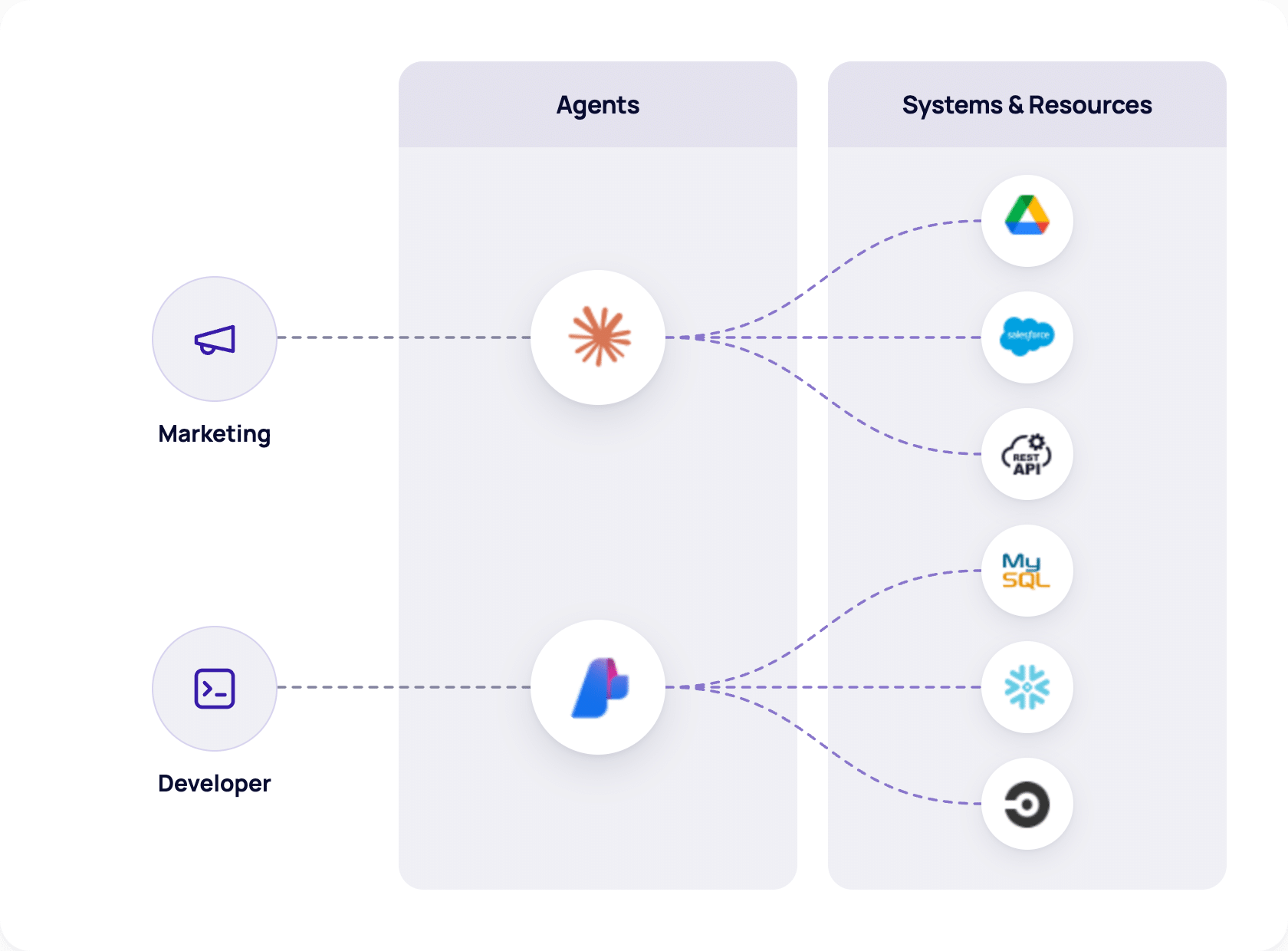
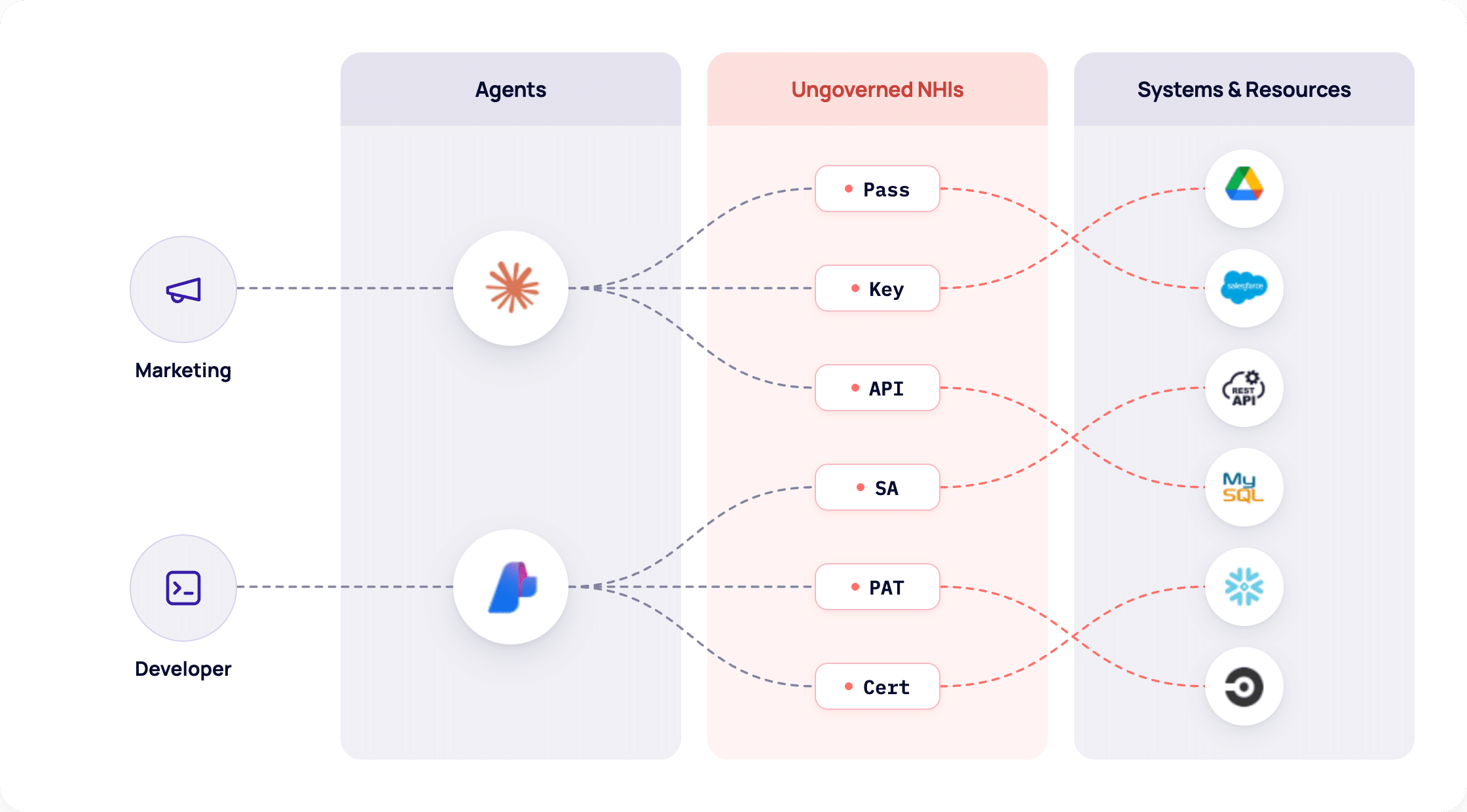
Picture two teams. A developer connects a coding agent to MySQL, Snowflake and CI. Marketing connects an agent to Drive, Salesforce and a REST API. Two agents, both approved. This is the picture most security teams have.

But to make them work, someone minted a password, a key, an API token, a service account, a personal access token and a certificate. Two agents. Six identities nobody inventoried. They weren’t provisioned as identities. They were created as a side effect of getting something to work, fast.

That’s why counting agents gives you the wrong number. The agents aren’t what touched your systems. Their credentials are. Every one of those identities needs a named owner, a place in a central inventory, and a risk profile: which systems it reaches, what data it can touch, and what happens if it’s compromised. An agent with read access to a wiki and an agent that can move money are not the same problem.

And every agent needs a kill switch. When one misbehaves or its credentials leak, the response can’t be a hunt for scattered keys across repos and config files. When each agent has a single verified identity, revoking it cuts off all access instantly, everywhere, in one action. If you can’t stop an agent in seconds, you don’t control it.

2. Don’t ask if the agent is secure. Ask what it’s allowed to do, and who decided.

The fastest way to connect an agent is to hand it a static key with broad permissions. That key usually carries whatever scope its creator had that day, serves every user the same way, and outlives the project, sometimes the employee. It works until it leaks. Then the attacker gets everything the agent can do, and often more.

The answer isn’t better secret rotation. It’s removing standing secrets altogether. Agents should authenticate as identities, not with shared keys, and receive least agency: only what the task requires, scoped to the user or team they act for, expiring when the task ends.

If an employee can’t delete a database, neither can their agent. That policy already lives in your identity provider. It just needs to extend to agents. Nothing to rotate, because nothing persists.

3. Don’t ask what happened after the incident. Ask what was stopped in the moment.

Plenty of tools produce polished risk dashboards and send alerts. That matters, but agents operate at machine speed. By the time the alert lands, the data is gone. And when you investigate, the log says “API key.” It doesn’t say which agent, which user, or which task.

The difference is between monitoring and enforcement. Real control sits in the path of the action itself: every agent request tied to an identity, checked against policy, allowed or blocked in real time, and recorded with full attribution. That delivers both protection and the ability to show regulators and the board exactly who did what, when and why.

Your new workforce needs identity-first security

What ties these questions together is a shift in how we think about enterprise identity. Your people get an identity, an owner, a lifecycle and offboarding. Your agents get a secret in a vault, or an env file, and a hope that someone remembers it exists.

AI agents are a new workforce: they operate like machines, decide like people, and multiply faster than both. They need to be managed like one.

Leadership doesn’t have to choose between speed and security. It needs to ask different questions: not how many agents, but what identities they run on; not whether they’re secure, but what they’re allowed to do; not what happened, but what was stopped.

Organizations that secure both the agent and the identity it runs on will scale AI with confidence. The rest will discover their shadow identities the hard way.

Find Every AI Agent and NHI, Free
Get a Demo