Table of Contents
The best alternatives to HashiCorp Vault fall into three primary architectural categories: cloud-native managed secrets services, developer-focused secrets managers, and secretless non-human identity platforms. While traditional alternatives continue to store static credentials inside encrypted databases, modern platforms eliminate static secrets by issuing scoped, just-in-time access directly to workloads. For organizations managing non-human identities such as deployment pipelines, container workloads, and autonomous agents, secretless architectures represent the most secure alternative to managing a central secrets vault.
Centralized secrets vaults require ongoing operational maintenance, continuous token rotation, and complex replication topology design. Storing static credentials inside any centralized database creates an attractive target for credential compromise and requires specialized engineering teams to monitor storage backends, seal states, and disaster recovery. Modern security architectures address these operational burdens either by offloading vault infrastructure to managed cloud providers or by removing static credentials entirely through verified runtime identity.
What are the best alternatives to HashiCorp Vault for managing secrets?
Evaluating alternatives to HashiCorp Vault requires classifying solutions by their underlying architectural approach rather than treating all secrets tooling as identical. The three core alternatives to a self-hosted HashiCorp Vault deployment are cloud-provider key management services, developer-centric synchronization vaults, and secretless non-human identity platforms.
Secrets management architectures have evolved past the initial model of centralizing static tokens into an encrypted database. While early secrets managers focused on safeguarding static API tokens and database credentials, modern engineering environments feature dynamic workloads that need short-lived authorization rather than stored secrets.
| Alternative Category | Core Mechanism | Operational Burden | Credential Storage Risk |
|---|---|---|---|
| Cloud-Native Managed Services | Hosted key-value stores bound to cloud-provider IAM | Low (managed infrastructure) | Medium (static secrets still persist in cloud storage) |
| Developer Secrets Platforms | Centralized dashboard syncing secrets into environment variables | Low to Medium | High (secrets sync into external CI/CD and developer machines) |
| Open-Source Forked Vaults | Self-hosted key-value and dynamic secrets engines | High (self-managed storage, unsealing, high availability) | Medium (central vault database contains plaintext on decryption) |
| Secretless Identity Platforms | Runtime identity attestation and just-in-time scoped access | Low | Minimal (eliminates static stored secrets and vault databases) |
Security teams choosing an alternative should determine whether their goal is simply replacing the underlying vault software or eliminating the operational overhead of managing static secrets altogether.
Why do engineering teams replace HashiCorp Vault?
Engineering teams replace HashiCorp Vault primarily to reduce operational complexity, escape restrictive software licensing terms, and lower the infrastructure burden of maintaining dedicated vault clusters. Running a self-hosted vault demands continuous platform engineering resources to manage high-availability storage backends, automated unsealing protocols, routine software upgrades, and multi-region synchronization.
Dedicated vault architectures also create significant developer friction. Application developers must learn proprietary API conventions, configure client token renewals, and handle vault connection failures gracefully inside application logic. When a vault cluster becomes unresponsive or enters a sealed state, dependent production services cannot authenticate, creating system-wide downtime.
Storage of static credentials represents another core reason teams migrate away from legacy vaults. When engineering teams store static secrets in a vault, those secrets still leak into environment variables, container layers, CI/CD run logs, and developer workstations. Managing secrets by merely storing them in a central repository fails to protect organizations against token theft once the secret is retrieved by a workload.
How do cloud-native secrets managers compare to centralized vaults?
Cloud-native secrets managers replace self-hosted vaults by delegating infrastructure management, high availability, and encryption-at-rest directly to major cloud providers. These services integrate natively with cloud identity and access management roles, eliminating the need to deploy and patch dedicated server instances or configure complex unsealing keys.
Cloud provider services simplify day-one operations for engineering teams committed to a single cloud ecosystem. Workloads running on managed cloud infrastructure authenticate directly using instance metadata and assigned runtime roles, bypassing the need for initial secret introduction problems common to traditional vault installations.
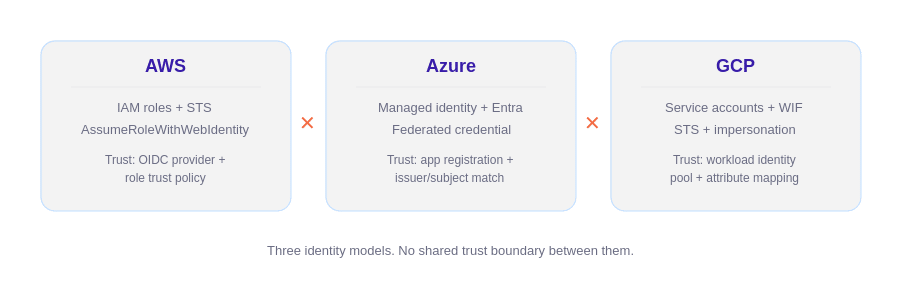
Multi-cloud enterprises, however, face architectural limitations when relying solely on cloud-native secret stores. Each cloud provider implements proprietary access control policies, unique API structures, and distinct audit logging formats. Platform teams operating across multiple cloud providers must maintain duplicate access policies and disparate operational workflows, recreating administrative complexity.
How does secretless access eliminate vault-stored credentials?
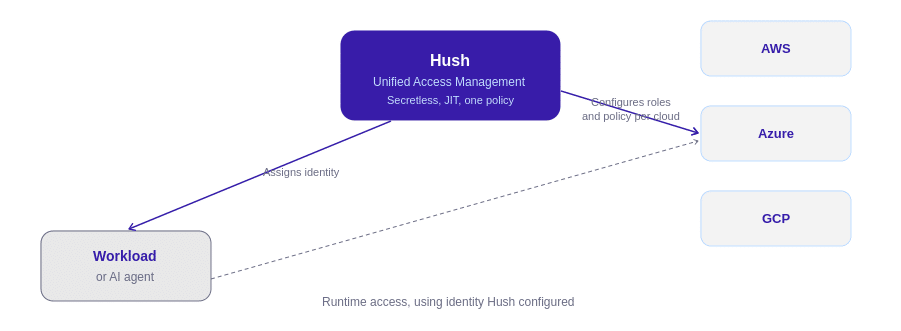
Secretless access platforms eliminate vault-stored credentials by replacing static API keys, tokens, and database passwords with real-time, identity-verified authorization. Instead of storing sensitive credentials in a vault and requiring applications to fetch them at runtime, workloads receive temporary, tightly scoped credentials minted dynamically for specific operations.
Non-human identities such as CI/CD pipelines, containerized microservices, background jobs, and autonomous agents represent the majority of access requests in modern cloud infrastructure. Traditional vaults treat these identities as consumers of static tokens, which leaves long-lived secrets susceptible to extraction from memory, logs, or compromised containers.
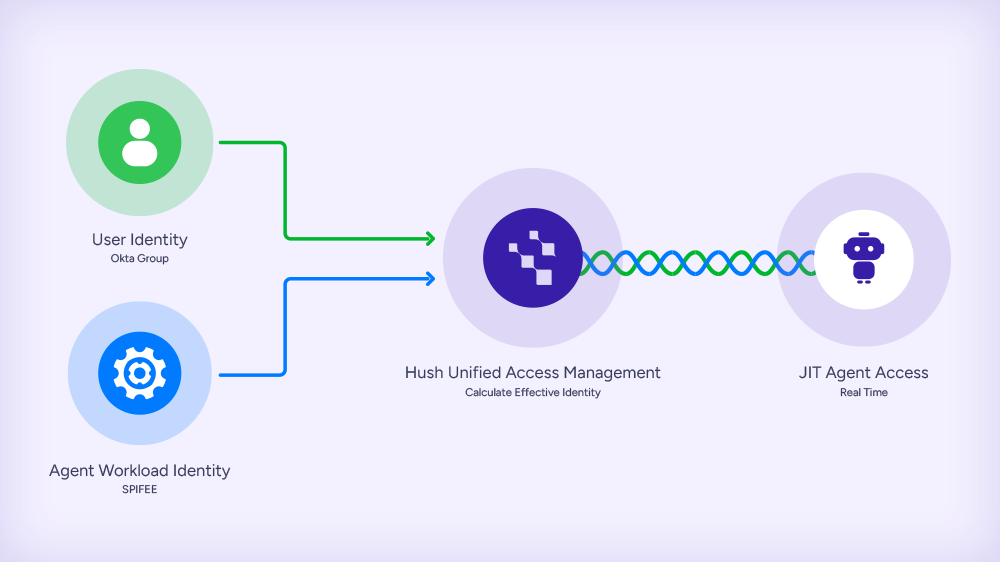
Runtime identity attestation evaluates the cryptographic provenance of a calling workload, confirming its binary hash, cloud environment, container namespace, and code repository before granting access. By validating identity at the moment of execution, platform teams remove the need to maintain static credentials inside vault databases, avoiding credential lifecycle management entirely.
Which alternative to HashiCorp Vault fits your security model?
Selecting an alternative to HashiCorp Vault depends on your organization’s deployment environment, engineering capacity, and security strategy regarding static versus dynamic credentials. Security architects should evaluate alternative solutions against specific infrastructure requirements:
- Single-Cloud Infrastructure: Teams running workloads strictly inside one cloud provider achieve the lowest operational overhead by adopting that provider’s native secrets management service, leveraging native IAM policies without cluster management.
- Existing Vault API Investments: Organizations with extensive codebase integrations written specifically for Vault APIs that require open-source licensing typically evaluate community-maintained open-source forks to minimize code rewrites.
- Developer Experience and App Configs: Early-stage development teams focused primarily on synchronizing configuration files and environment variables across staging environments benefit most from developer-centric SaaS secrets managers.
- Zero-Trust and Non-Human Identity Modernization: Enterprises managing microservices, automated pipelines, and artificial intelligence agents across diverse environments achieve the highest resilience by adopting secretless identity architectures that remove stored secrets from the attack surface.
Security teams evaluating these options must weigh the recurring labor of operating vault infrastructure against the security benefits of removing stored credentials from application memory.
How to evaluate your migration path away from HashiCorp Vault
Platform engineering teams planning a migration away from HashiCorp Vault should begin by cataloging the exact types of secrets stored within their current clusters. Auditing secrets usage reveals whether your workloads consume static third-party API keys, database credentials, internal service tokens, or public key infrastructure certificates.
Categorizing secrets by consumer type establishes whether your primary migration challenge is developer tooling or non-human workload authentication. Applications that rely on static database passwords can frequently be modernized to consume short-lived identity tokens, removing the need to migrate those secrets into a replacement vault.
Identity security assessments determine whether replacing HashiCorp Vault with another centralized vault solves your core security challenge. While swapping vault engines can reduce software licensing costs or cluster maintenance, migrating to secretless non-human identity access eliminates credential rotation failures, unauthorized token reuse, and static secret storage risks at the architectural level